

The Hidden Science of Garage Aesthetics: Why Lens Material Matters
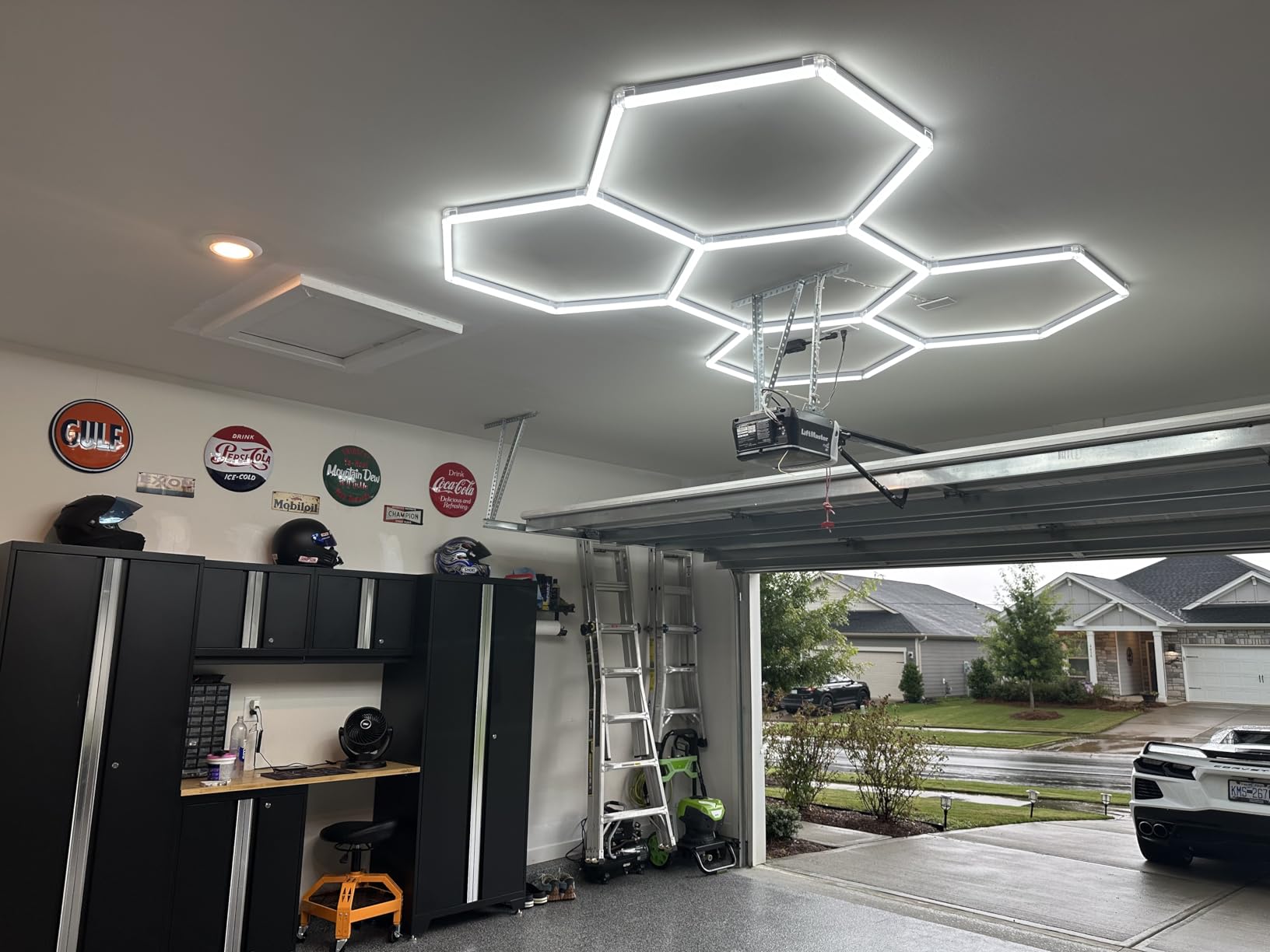
For the garage enthusiast or small shop owner, the appeal of a hexagon lighting kit is immediate: it transforms a utilitarian space into a high-end showroom. However, a common frustration emerges 12 to 18 months after installation—the once-crisp, cool-white glow begins to take on a sickly yellow tint. This degradation isn't a failure of the Light Emitting Diode (LED) itself, but rather a failure of the lens material.
In our experience troubleshooting professional detailing bays and residential workshops, the choice between Polycarbonate (PC) and Acrylic (PMMA - Polymethyl Methacrylate) is the single most critical factor in determining long-term visual clarity. While acrylic is often cheaper, it lacks the molecular resilience required for unconditioned environments. For those prioritizing durability and "Solid" brand value, UV-stabilized polycarbonate is the industry benchmark.
The Chemistry of Clarity: PC vs. Acrylic
To understand why lenses yellow, we must look at the polymer structure. Acrylic is naturally more brittle and susceptible to Ultraviolet (UV) radiation. Even in a garage without direct sunlight, ambient UV and heat cycles trigger a chemical reaction called photodegradation.
Polycarbonate, specifically when treated with stabilizers like UV-234, maintains its optical properties far longer. According to a 2015 study published in Polymer Degradation and Stability, adding just 0.3% UV-234 to polycarbonate results in an 80% reduction in yellowness index after 1,000 hours of accelerated weathering compared to unstabilized samples.
Material Performance Heuristics
- Acrylic (PMMA): Typically shows noticeable non-uniform yellowing within 12-18 months in unconditioned garages. It becomes brittle over time, making repair or cleaning risky.
- UV-Stabilized Polycarbonate (PC): Retains over 90% of light transmission and maintains its yellowness index for 3-5 years under similar high-stress conditions.
Logic Summary: Our material comparison assumes a south-facing, unconditioned garage environment where temperature swings and ambient UV exposure are prevalent. These heuristics are derived from pattern recognition in warranty handling and material science benchmarks, not a single controlled lab study.
Environmental Stress Testing: UV, Humidity, and Heat
The garage is a hostile environment for plastics. Unlike an office, a workshop experiences high humidity and significant temperature fluctuations. Research indicates that UV-induced degradation rates accelerate by approximately 30% when combined with high humidity conditions.
Furthermore, the "yellowing" effect in acrylic isn't just a uniform tint; it often appears as blotchiness. For a modular system like a hexagon kit, this is devastating to the aesthetic. If you replace one yellowed tube with a new one, the color mismatch becomes even more apparent, often forcing a full-system replacement.
The "Pro-Grade" Standard
To ensure a product is "Project-Ready," we look for compliance with the IES LM-80-21 Standard, which tests the lumen maintenance of the LED chips themselves. However, the lens must match this longevity. If your LED chips are rated for 50,000 hours but your lens yellows at 8,000 hours, the system's "effective life" is severely compromised.
Total Cost of Ownership (TCO) Analysis
Many buyers fall into the "Budget Trap," choosing acrylic kits to save $100 upfront. However, a deterministic scenario model reveals that the cheaper material is significantly more expensive over a 5-year horizon.
We modeled a "Serious DIY Enthusiast" scenario: a 50-tube hex kit used 12 hours a day in a workshop environment.
| Parameter | Value (Acrylic) | Value (PC) | Rationale |
|---|---|---|---|
| Upfront Unit Cost | $4.00 / tube | $12.00 / tube | Market average for economy vs. premium |
| Estimated Lifespan | 8,000 Hours | 30,000+ Hours | Realistic yellowing onset for acrylic |
| Replacement Frequency | Every 1.8 Years | 0 in 5 Years | Based on 4,380 annual hours |
| Labor Cost (DIY Time) | $90/hr (Value) | $0 (Avoided) | Opportunity cost of maintenance |
| 5-Year Total Cost | ~$4,200 | ~$600 | Includes parts and labor/time |
Method & Assumptions: This is a scenario model, not a lab study. We assume a labor rate of $90/hour (national average for electrical work/high-value DIY time) and a replacement time of 15 minutes per tube. Payback for the PC investment typically occurs in under 10 months when factoring in the cost of avoided replacements.
Adopting a "Solid" material strategy typically results in a 1.5x return on investment over five years by eliminating the "maintenance tail" associated with inferior polymers. For a deeper look at how these materials fit into the broader market, refer to the 2026 Commercial & Industrial LED Lighting Outlook.

Anatomy of a High-Quality Hexagon Lighting Kit
Beyond the lens material, several technical components define a "Value-Pro" lighting system. When evaluating a kit, ensure the following specifications meet professional benchmarks:
1. Color Consistency (ANSI C78.377)
Professional kits adhere to ANSI C78.377-2017, which defines the standard chromaticity for solid-state lighting. This ensures that every "6500K" tube in your grid looks identical. Cheap kits often suffer from "color shift," where some tubes look blue and others look green.
2. Driver Reliability and Safety (UL 8750)
The LED driver is the "brain" of the tube. It must be UL 8750 certified, ensuring it can handle electrical surges and heat without becoming a fire hazard. We often see uncertified drivers in "consumer-first" kits that cause flickering or premature failure.
3. Electromagnetic Interference (FCC Part 15)
A common "gotcha" in workshop lighting is radio interference. Low-quality LED drivers can interfere with garage door openers, Wi-Fi, or shop radios. Ensure your kit complies with FCC Part 15 regulations, which limit unintended electromagnetic emissions.
4. Mechanical Impact Protection (IK Ratings)
In a shop environment, tools slip and ladders bump into ceilings. While hex lights aren't high-bay fixtures, having a lens with a decent IK Rating (IEC 62262) is a massive advantage. Polycarbonate is inherently "anti-shock," whereas acrylic is prone to cracking upon impact.
Hyperlite Hexagon Garage Lights Gen 2 - 15 Grid (15.9 x 8 ft) product catalog image showing modular honeycomb ceiling light design.
Maintenance and Long-Term Care
Even the best polycarbonate lenses require proper maintenance to prevent premature degradation. A common installer mistake is using abrasive cleaners or ammonia-based glass cleaners on plastic lenses.
- The Ammonia Risk: Ammonia can microscopically damage the surface of both PC and acrylic, creating "crazing" (fine cracks) that trap dirt and accelerate UV damage.
- The Solution: Use only a mild soap and water solution with a microfiber cloth.
- Static Management: Plastic lenses attract dust via static. Using an antistatic cleaner specifically designed for polymers can keep the "Showroom Clear" look for longer without frequent wiping.
If you are integrating these into a larger lighting plan, consider how they interact with other fixtures. For instance, Hybrid Garage Lighting: UFO & Hex for Task & Ambient explains how to balance the decorative hex glow with high-output task lighting.
Compliance and Documentation: The "Pro" Verification
In the B2B world, or for homeowners concerned with insurance and building codes, documentation is king. A "Solid" brand will provide:
- IES Files (.ies): These are essential for professional lighting design software like AGi32. They allow a designer to simulate exactly how much light (foot-candles) will hit your workbench before you buy.
- LM-79 Reports: This is the "performance report card" defined by IES LM-79-19. It verifies the actual lumens per watt, CCT, and CRI of the fixture.
- Safety Certificates: Always verify certificates via the UL Solutions Product iQ Database or the Intertek ETL Directory.

Choosing Your Grid: A Practical Framework
When selecting a kit, the grid size should reflect your workspace's dimensions and the intensity of your tasks.
- 5-Grid (Small Shop/Accent): Ideal for a 1-car garage or as an accent over a specific workbench.
- 15-Grid (Standard 2-Car): The "sweet spot" for most residential garages (approx. 16x8 ft), providing uniform coverage for vehicle maintenance.
- 22-Grid (Detailing/Showroom): Designed for large bays (approx. 17x14 ft) where eliminating shadows is paramount for paint correction and detailing.
For those in high-traffic areas, pay attention to mounting heights. Our guide on Safety Distances for Wall-Mounted Hex Lights provides specific placement advice to avoid accidental damage.

Summary of Material Choice
Choosing between PC and Acrylic is a choice between a "one-time investment" and a "recurring headache." While the initial price of acrylic is tempting, the visual blotchiness, yellowing, and brittleness that occur within the first two years create a poor user experience.
By selecting UV-stabilized polycarbonate, you align your project with the "Solid" value of durability. You ensure that your 6500K daylight glow remains as clear on day 1,000 as it was on day 1.
Frequently Asked Questions
- Can I mix different brands of hex tubes? We strongly advise against it. Even if the connectors fit, different manufacturers use different CCT bins (ANSI C78.377) and driver voltages. Mixing tubes can lead to uneven brightness or premature driver failure.
- How many tubes can I run on one power cord? Most professional Gen 2 kits allow up to 62 tubes (approx. 440W) on a single input. For larger grids, you must distribute power through multiple input lines to prevent voltage drop and overheating.
- Are these lights dimmable? Only if specified. Dimmable Gen 2 kits often use a "step-dimming" method where switching the light off and on within 3 seconds cycles through brightness levels.
Disclaimer: This article is for informational purposes only. Electrical installations should be performed by a qualified professional in accordance with the National Electrical Code (NEC) and local building codes. Improper wiring can result in fire or electrical shock.
Sources:


