

Why a 5-Year Warranty is a Roadmap to Quality Garage Lighting
Key Takeaways: The "Value-Pro" Checklist Before diving into the technical details, here is what you should look for when evaluating a hexagon lighting kit for your shop or garage:
- Warranty: A 5-year warranty often correlates with higher-grade internal components like 105°C capacitors.
- Efficiency: Look for L70 ratings (at least 50,000 hours) to ensure the light won't dim significantly within the first few years.
- Safety: Prioritize UL or ETL-listed kits to ensure compliance with insurance and fire safety standards.
- Installation: Never exceed the manufacturer’s wattage limit (typically 440W per power feed) to avoid thermal damage.
Why Your Warranty Matters for Your Shop’s Future
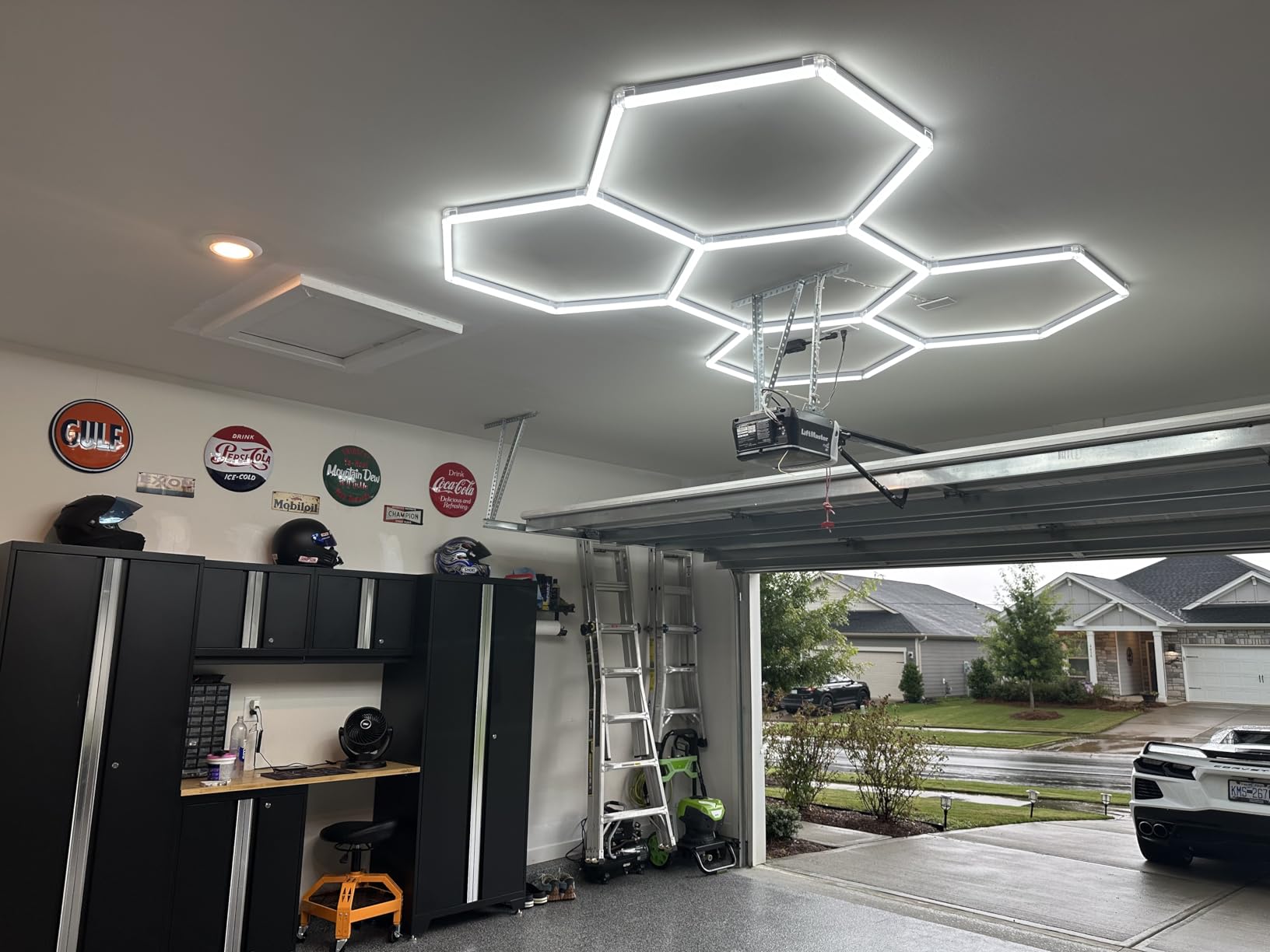
Picture this: It’s a Saturday afternoon in mid-July. You’re in your garage, the humidity is thick, and you’re finishing up a detailing job. You flip the switch for your hexagon grid, expecting that crisp, daylight glow, but instead, half the grid flickers. You check the breaker and the plug—everything seems fine. The likely culprit? A small internal component that couldn't handle the ambient heat.
When browsing for lighting, it’s easy to focus on the "cool factor" of a honeycomb layout or the 6500K brightness. However, based on common patterns we see in repair and customer support, the most reliable indicator of long-term performance isn't the initial lumen count—it’s the warranty period.
A 5-year warranty is often a technical signal. It reflects the manufacturer's confidence in the parts you can’t see. In this guide, we’ll break down the anatomy of a high-quality hex kit to show why a "Value-Pro" investment is a practical way to ensure your shop stays bright.
The Driver: A Common Point of Failure
If the LED chips are the "muscles," the driver is the "heart." It converts high-voltage AC from your wall into the steady DC your lights require. Based on our practical observations of DIY lighting kits, the driver is frequently the primary point of failure.
Inside every driver are electrolytic capacitors, which are sensitive to heat.
- Standard Kits: Often use capacitors rated for 85°C (185°F). In a poorly ventilated garage ceiling during summer, these can reach their thermal limits quickly.
- Professional-Grade Kits: A common industry heuristic is that kits backed by a 5-year warranty typically utilize 105°C-rated capacitors. These are better equipped for the thermal stress of ceiling mounting.
According to the IES LM-79-19 Standard, stable power delivery is essential for consistent performance. While a 5-year warranty isn't a 100% guarantee of specific internal parts, it generally indicates a design intended for a longer "mean time between failures" (MTBF).

LED Chips: L70 and Binning
Have you ever noticed a budget LED light turning yellow or dim after a year? This is "lumen depreciation." All LEDs dim over time, but the rate depends on chip quality and thermal management.
Professional-grade kits often reference the IES LM-80-21 Standard, where chips are tested for at least 6,000 hours. Engineers use the IES TM-21-21 Standard to project future brightness.
- L70 at 50,000 Hours: This means that after 50,000 hours, the light should still produce at least 70% of its original brightness.
- Binning: Premium kits use "tight binning," ensuring every hex tube matches in color. Lower-quality kits may use "mixed bins," leading to visible color shifts (e.g., some tubes looking slightly blue or pink) within months.
The "Flicker-Free" Advantage
For those doing product photography or filming in their garage, cheap drivers can cause distracting lines in phone photos. High-quality kits are designed to be "flicker-free," a feature highlighted in the 2026 Commercial & Industrial LED Lighting Outlook.
Engineering for the "Garage Climate"
Garages are tough on electronics due to dust, moisture, and temperature swings. For a kit to remain reliable, several design features are important:
- Polycarbonate (PC) Construction: Unlike some plastics that become brittle under UV exposure, high-quality PC is designed to remain flexible and clear.
- Connector Integrity: In humid environments, look for friction-fit designs that resist dust and moisture.
- Thermal Dissipation: LEDs convert a significant portion of energy into heat. According to research from Vossloh-Schwabe, effective housing design must act as a heatsink to prevent the chips from overheating.

The Math of Reliability: ROI Modeling
While premium kits have a higher upfront cost, they can pay for themselves through energy and maintenance savings. Below is a 5-year projection for a typical shop upgrade.
TCO & ROI Assumptions (5-Year Model)
This is a scenario-based estimation for a shop replacing 1,000W of legacy lighting (e.g., Metal Halide) with two 150W Hexagon Systems (300W total).
| Parameter | Value | Unit | Rationale |
|---|---|---|---|
| LED System Wattage | 300 | W | Two standard hex grids |
| Electricity Rate | 0.16 | $/kWh | US regional average |
| Annual Usage | 3,000 | Hours | Moderate shop use (10 hrs/day, 300 days) |
| Energy Reduction | 700 | W | 1,000W (Legacy) - 300W (LED) |
| Maintenance Savings | ~$150 | $/Year | Estimated bulb/ballast replacement & labor |
Projected 5-Year Results:
- Total Energy Savings (5 Years): ~$1,680 (Calculation: 0.7 kW saved x 3,000 hrs x $0.16/kWh x 5 years).
- Total Maintenance Savings (5 Years): ~$750 (Estimated avoidance of legacy component failures).
- HVAC Cooling Credit: ~$120 (Estimated reduction in AC load due to lower heat output).
- Estimated Payback Period: Roughly 14–18 months depending on initial kit price.
By choosing a kit with a 5-year warranty, you are essentially protecting your investment through the entire payback period and beyond.

Installation: Avoiding Common Pitfalls
Even a high-quality kit can fail if installed incorrectly.
The 440W Limit
Most professional-grade hexagon kits have a maximum wattage limit for a single power cable—frequently 440W (roughly 60–65 tubes). Exceeding this limit can overload internal wiring and the driver, potentially voiding your warranty and creating a safety hazard.
Compliance and Safety
For commercial or professional home-shops, look for UL or ETL listing marks. These certifications indicate the product has been tested to meet specific safety standards. Using non-certified lighting may impact insurance claims in the event of an electrical issue.
Pro-Install Checklist:
- Voltage Tester: Ensure your outlet is properly grounded.
- Cable Ties: Keep power cables clear of moving garage door parts.
- Power Injection Points: If your grid exceeds 60 tubes, use multiple power feeds to distribute the load evenly.
- Dielectric Grease: In high-humidity areas, applying a small amount of non-conductive dielectric grease to connector pins can help prevent corrosion.

Final Thoughts on Value
Choosing a hexagon lighting kit is an investment in your productivity. By focusing on the warranty and technical specifications rather than just the lowest price, you are prioritizing the quality of the capacitors, LED binning, and thermal engineering.
A 5-year warranty is a strong indicator that a manufacturer has built a product to withstand the rigors of a working shop. For the serious DIYer, that reliability is the difference between a project that shines and one that leaves you in the dark.
Disclaimer: This article is for informational purposes only. Electrical installations should be performed in accordance with the National Electrical Code (NEC) and local building codes. If you are not comfortable with electrical wiring, please consult a licensed electrician.


