

The Brightness Trap: Why Your Garage Needs Lumens, Not Just Watts
Imagine walking into your garage after a long day, ready to tackle that detailing project or organize your tool bench. You flick the switch, and… it’s a muddy, yellowish gloom. You bought the "highest wattage" lights you could find on a budget, thinking more power equaled more light. But as you squint to find a 10mm socket, you realize something is wrong. The garage is hot, your electricity meter is spinning like a top, and the light still feels "thin."
I’ve seen this scene play out in hundreds of workshops and home garages. For years, we were trained to look at wattage as the primary indicator of brightness because of old incandescent bulbs. In the world of modern LED hexagon lighting, however, wattage is actually a measure of cost, not performance. If you want maximum brightness on a budget, you need to stop looking at the power draw and start looking at the light output—the lumens.
In this guide, we’re going to pull back the curtain on the anatomy of high-quality hexagon lighting. We’ll explore why "lumens per tube" is the only metric that truly matters, how to spot the technical red flags that lead to early failure, and how to plan a layout that turns your garage into a professional-grade workspace without breaking the bank.
Anatomy of a High-Quality Hexagon Lighting Kit
When you’re shopping for a hexagon kit, it’s easy to get distracted by the cool "honeycomb" aesthetic. But the real magic happens inside those polycarbonate tubes. A premium kit isn't just about the shape; it's about the synergy between the LED chips, the driver, and the physical connectors.
The LED Chip: The Engine of Light
Not all LEDs are created equal. The "efficacy" of a light (measured in lumens per watt or lm/W) tells you how efficiently the chip converts electricity into visible light. According to the DesignLights Consortium (DLC), high-performance industrial LEDs often reach efficacy levels that allow for massive energy savings compared to older tech.
In our experience troubleshooting shop setups, we’ve found that kits using "lower-bin" LEDs often struggle with lumen depreciation. This means they might start bright, but within 12 months, they lose 20-30% of their output because the chips can't handle the heat. A high-efficacy chip (aiming for 110-130 lm/W) runs cooler, lasts longer, and provides a much more stable light source.
The Driver: The Silent Workhorse
The driver is the "brain" of your lighting system, converting your home’s AC power into the DC power LEDs need. Budget kits often use non-isolated drivers to save money. These are highly susceptible to voltage fluctuations. If your neighbor starts a heavy compressor or your HVAC kicks in, non-isolated drivers can cause noticeable flickering or, worse, a total circuit failure.
We always recommend looking for isolated drivers. They provide a "buffer" between the power grid and the delicate LED chips, ensuring a constant current output. This is what prevents that annoying strobe-light effect that can cause eye strain during a long afternoon in the shop.
Connectors: The Weakest Link
The most common point of failure in modular hexagon kits isn't the light itself—it's the plastic connector. Cheap connectors without positive locking mechanisms are a nightmare for DIYers. If the connection is loose, you’ll deal with flickering sections or entire grids going dark if you accidentally bump a tube while moving a ladder. High-quality kits use reinforced polycarbonate connectors that "click" into place, ensuring a solid electrical path across the entire grid.
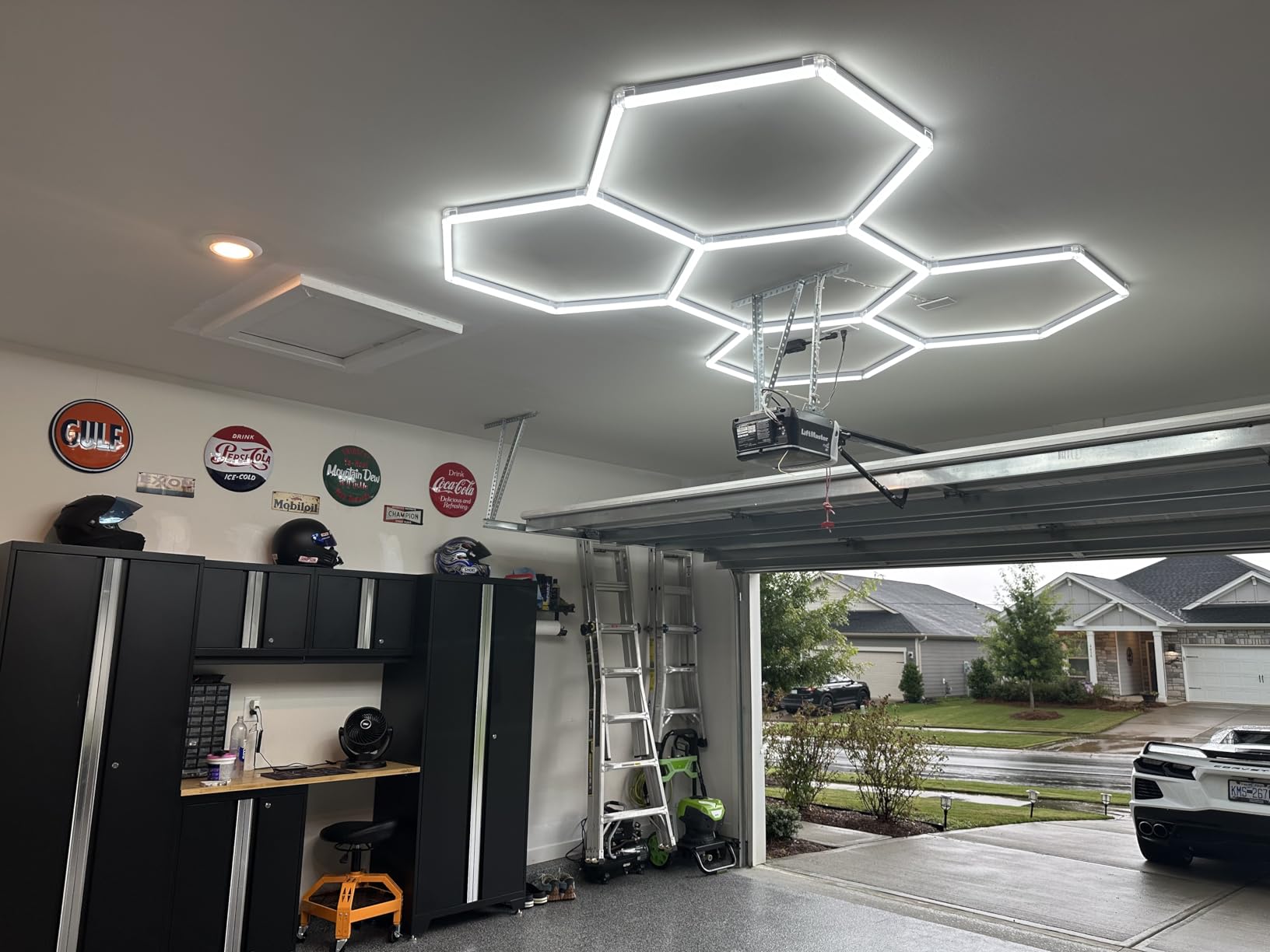
The Math of Maximum Brightness: Lumens Per Square Foot
How much light do you actually need? This is where most people guess and get it wrong. If you’re just parking a car, you don't need much. But if you’re doing automotive detailing, woodworking, or mechanical repairs, "standard" lighting won't cut it.
Based on IES Standards for Garage Lighting, a professional workspace should aim for a specific "foot-candle" level at the work surface. For detailed tasks like paint correction or engine work, we generally target around 80-90 foot-candles.
Modeling the "Serious Enthusiast" Garage
To show you how this works in the real world, we modeled a scenario for a standard two-car garage (24x24 ft) with a 10 ft ceiling. We compared a "Budget Kit" (lower efficacy) against a "Premium Kit" (higher efficacy) to see which one delivered better value over time.
Logic Summary: This analysis assumes a target of ~87 foot-candles at a 2.5 ft workbench height, using the Zonal Cavity Method to calculate total required lumens.
| Parameter | Value | Unit | Rationale |
|---|---|---|---|
| Garage Dimensions | 24 x 24 | ft | Standard residential 2-car garage |
| Target Illuminance | 87.5 | fc | IES recommendation for detailing/paint |
| Total Lumens Required | ~91,500 | lm | Calculated for uniform coverage |
| Budget Kit Efficacy | 80 | lm/W | Typical of "cheap" uncertified kits |
| Premium Kit Efficacy | 120 | lm/W | Industry standard for high-performance LED |
The Modeling Result: While both kits could technically reach the lumen target, the Premium Kit required significantly less power to do so. Over a 10-year horizon, the energy savings alone totaled roughly $151 annually (based on average US residential rates of $0.14/kWh). More importantly, the premium chips generate less heat, which is critical in a garage environment where temperatures can soar in the summer.
Understanding the "Nutrition Label" of Your Lights
If you want to be a savvy buyer, you need to look past the marketing fluff. There are two "performance reports" that act as the nutrition labels for LEDs: LM-79 and LM-80.
- LM-79: This is the performance "snapshot." It measures the total lumens, efficacy, and color quality (CRI) of the entire fixture. If a manufacturer can't provide an IES LM-79 report, they are likely guessing their brightness numbers.
- LM-80: This measures "lumen maintenance." It tells you how much the light will dim over 6,000+ hours of use. We use this data to project the long-term lifespan ($L_{70}$) of the lights.
When you see a kit claiming "100,000 hours of life" without an IES TM-21 projection based on LM-80 data, be skeptical. Most high-quality consumer kits are realistically rated for 30,000 to 50,000 hours. That’s still decades of use for a hobbyist, but it’s an honest number you can trust.

Installation Logic: Wiring and NEC Compliance
One of the biggest "gotchas" with hexagon lights is the power injection. Most hexagon tubes are designed to be daisy-chained, but there is a physical limit to how much current can run through those thin internal wires.
The 440W Rule
A common manufacturer limit is 440W per power injection point. In our "Serious Enthusiast" model, a full 9-fixture grid drew about 441W. While that’s close, it technically requires two power injection points to stay within safe operating limits and prevent voltage drop at the far end of the grid.
Voltage drop is why the last few hexagons in a large DIY chain sometimes look dimmer than the ones near the plug. By splitting your power input, you ensure every tube gets the same voltage, resulting in uniform brightness across the whole ceiling.
Safety First: UL and ETL
In the US, your electrical insurance and local building codes often require lighting to be "Listed." This means it has been tested by a National Recognized Testing Laboratory (NRTL) like UL Solutions or Intertek (ETL).
We often see "UL Recognized" components in cheap kits, but that’s not the same as the entire kit being UL Listed. A "Recognized" part is just a component; a "Listed" fixture means the whole assembly—wires, connectors, and tubes—is safe for your home. Always look for the UL 1598 standard for general luminaires to ensure your garage stays safe.
Visual Comfort: CRI and CCT Explained
Brightness isn't just about quantity; it's about quality. Two terms you’ll see often are CCT and CRI.
- CCT (Correlated Color Temperature): This is the "color" of the light, measured in Kelvin (K). Most hexagon kits are 6500K, which is a very crisp, "cool white" similar to an overcast day. This is excellent for staying alert and seeing fine details, but some find it too "blue" for a home environment. For a balance of professional visibility and comfort, 5000K (Daylight) is often the sweet spot.
- CRI (Color Rendering Index): This is how accurately the light shows colors. If you’re painting a car or matching wood stains, you need a high CRI (>90). Low CRI lights make everything look gray or washed out, which can lead to mistakes that you won't see until you pull the project out into the sun.
Pro Tip: If you’re doing paint correction, don't just go for the brightest light. Go for the light with the highest CRI. It will reveal the "swirl marks" and imperfections that a high-wattage, low-quality light will hide.

What to Expect: Maintenance and Longevity
Once your hexagon grid is up, what should you expect? If you’ve chosen a kit with high efficacy and solid connectors, the maintenance should be near zero. However, there are a few things to keep in mind:
- Dust Management: In a workshop, dust will settle on the top of the tubes. Because these lights have a wide surface area, a thick layer of dust can actually act as an insulator, trapping heat and shortening the LED life. A quick blast with compressed air once or twice a year keeps them running cool.
- The "Burn-In" Period: It’s normal for LEDs to lose a tiny fraction of their initial "out-of-the-box" brightness in the first 100 hours. This is called "seasoning." After that, a quality kit will maintain stable output for years.
- Warranty Peace of Mind: Look for a 2-year to 5-year warranty. This is your safety net against "infant mortality"—the rare case where a driver or chip fails early due to a manufacturing defect.
Quick Checklist for the Budget-Conscious Buyer
- [ ] Check the Lumens per Watt (lm/W): Aim for 110 or higher.
- [ ] Verify Certification: Look for UL Listed or ETL Listed marks.
- [ ] Inspect the Connectors: Ensure they have a secure, locking design.
- [ ] Confirm CRI: Look for CRI >90 for any detailing or color-sensitive work.
- [ ] Calculate Your Load: Don't exceed 440W per power cord.
For a deeper dive into how these standards apply to commercial-grade setups, check out the 2026 Commercial & Industrial LED Lighting Outlook.
Choosing the right hexagon lights is about more than just a cool pattern on the ceiling. It’s about creating an environment where you can do your best work safely and efficiently. By focusing on lumens and efficacy rather than just wattage, you’re not just buying a light—you’re investing in the future of your workshop.
Disclaimer: This article is for informational purposes only and does not constitute professional electrical or safety advice. Always consult with a licensed electrician for installation and ensure all projects comply with the National Electrical Code (NEC) and local building regulations.
References:


