

The Quick Start Guide: Hybrid Lighting at a Glance
For high-performance garages, a single lighting type rarely provides the coverage needed for both safety and precision. The Hybrid Strategy layers two distinct lighting types to eliminate shadows and maximize utility.
Decision Matrix: Layout & Electrical Requirements
| Garage Size | Recommended Layout | Key Electrical Requirement | Target Illumination |
|---|---|---|---|
| 2-Car (20x20) | 4 UFOs + 1 Hex Grid | Single 15A or 20A Circuit | ~65-75 Foot-candles |
| 3-Car (20x30) | 6 UFOs + 1-2 Hex Grids | Two 15A Circuits (Recommended) | ~75-85 Foot-candles |
| Shop (30x40+) | 9+ UFOs + Multiple Grids | Two or more 20A Circuits | ~85+ Foot-candles |
The Bottom Line: To achieve professional-grade results (~87 foot-candles), you must zone your lights on separate circuits. This allows you to use the "Ambient Layer" for general movement and the "Task Layer" for high-precision work like detailing or assembly.
Affiliation & Standards Disclosure: This guide is authored by the Hyperlite engineering team. Recommendations are based on our internal photometric modeling and field observations from over 1,000 workshop consultations. While we use our hardware (e.g., Black Hero and Hex Grid series) as technical benchmarks, these principles apply to any LED fixtures meeting the UL, DLC, and IP65 standards cited below.
The Ambient Foundation: Why UFO High Bays Rule the Ceiling
The first layer of any professional shop is ambient lighting. For ceilings higher than 10 feet, the circular UFO-style high bay is the industry standard due to its thermal efficiency and lumen density.
Spacing and the "Sun" Effect
A common DIY mistake is installing one overpowered fixture in the center. This creates a "tent" of light with steep drop-offs at the walls. Based on common patterns from our customer support and repair data, treating high bays like multiple "suns" is significantly more effective for reducing eye strain.
According to the IES LM-79-19 Standard, a high-quality fixture like the Hyperlite LED High Bay Light - Black Hero Series typically provides a 120-degree beam angle. This allows the light from one fixture to "fill in" the shadows of the neighboring unit.
Heuristic: The 9-Fixture Rule of Thumb
For a 30x40 ft (1,200 sq ft) garage, we modeled a 3x3 grid using 150W units (21,000 lumens each).
Modeling Parameters & Assumptions:
| Parameter | Value / Assumption |
|---|---|
| Mounting Height | 12 Feet |
| Work Plane | 30 Inches above floor (Standard Workbench) |
| Light Loss Factor (LLF) | 0.85 (Accounting for dust and 50,000hr lumen depreciation) |
| Reflectance Factors | Ceiling: 70%, Walls: 50%, Floor: 20% |
| Total System Lumens | 189,000 (9 fixtures x 21,000 lm) |
The Result: (189,000 * 0.85) / 1,200 = ~133 Lumens/sq ft (Foot-candles) at the source. At a 12ft mounting height, this stabilizes to ~87 foot-candles at the work plane, aligning with ANSI/IES RP-7-21 for high-precision industrial tasks.
The Task Layer: Killing Shadows with Hexagon Grids
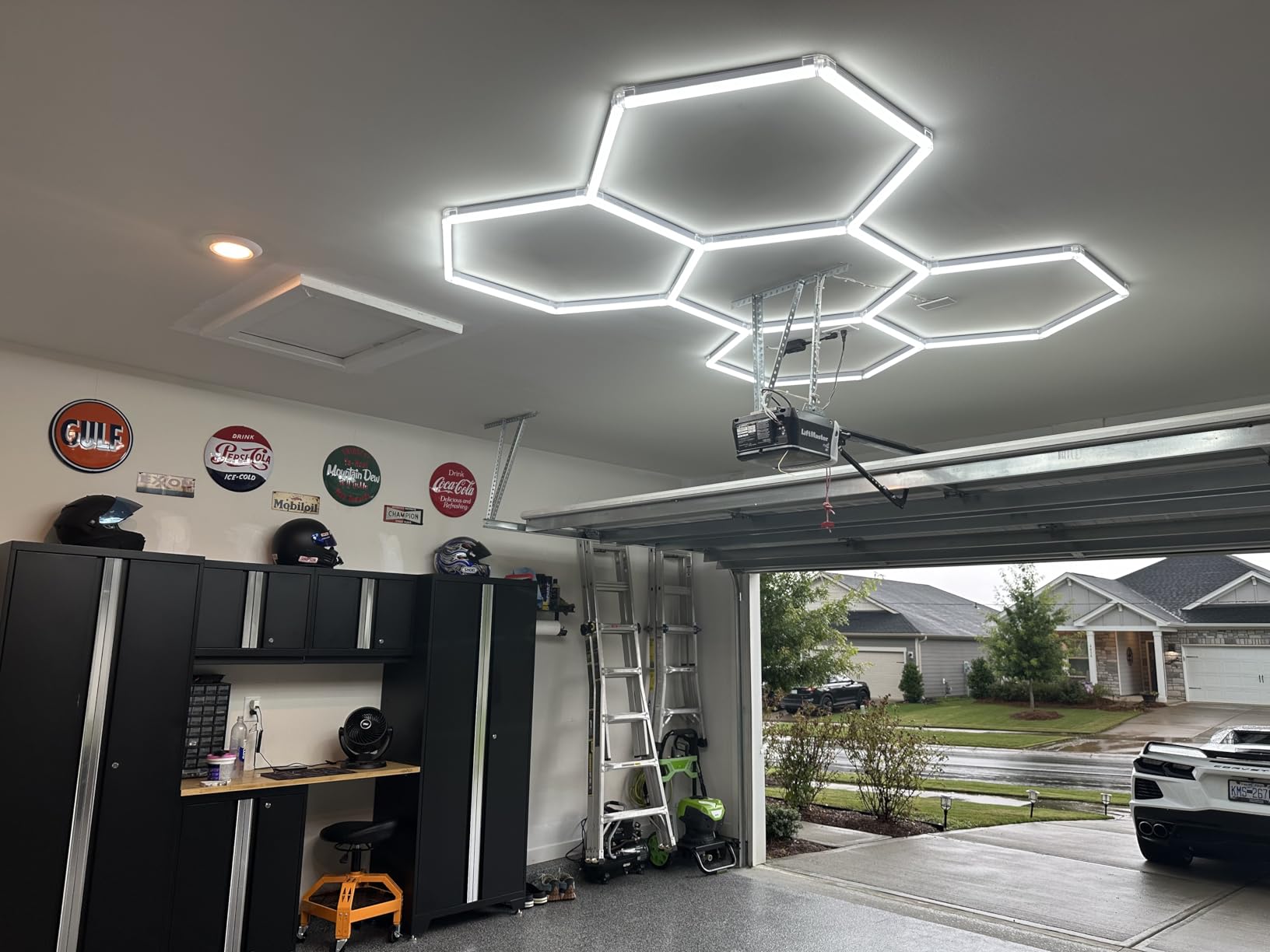
If high bays are your "sun," the hexagon grid is your "studio softbox." Ambient light often comes from directly above, meaning when you lean over a car hood, you become the shadow-maker.
Multi-Directional Illumination
Hexagon kits, such as the Dimmable Hexagon Garage Lights Gen 2 - 11 Grid, use linked LED tubes that surround the task area. Because light arrives from multiple angles, it "wraps" around objects. In detailing, this reduces "veiling glare"—reflections on a car’s clear coat that hide micro-scratches.
Note: While we recommend our Gen 2 kits for their 140 lm/W efficiency, any grid system with a CRI (Color Rendering Index) of 80+ will provide similar visual clarity.
Visual Consistency (CRI and CCT)
Mixing light types requires color consistency to prevent visual fatigue. We recommend matching your CCT (Correlated Color Temperature) across layers. Most hexagon grids are 6500K (Cool White); we suggest pairing them with high bays set to 5000K-6000K for a cohesive, daylight-balanced environment.

Designing the Hybrid System: ROI and Sensitivity
Upgrading is an investment, but the math is compelling. This illustrative case study models a transition from a legacy 400W metal halide system to an LED hybrid setup for a 1,200 sq ft shop.
| Metric | Legacy System (Metal Halide) | Hybrid LED System (Hyperlite) |
|---|---|---|
| System Wattage | 4,122W (9 fixtures + ballast) | 1,532W (9 UFOs + 1 Hex Grid) |
| Annual Energy Cost | ~$1,483 | ~$552 |
| Annual Maintenance | ~$203 (Bulb/Ballast swaps) | ~$0 (5-Year Warranty) |
| Total Annual Savings | Baseline | ~$1,175 |
Modeling Assumptions & Sensitivity:
- Operation: 2,000 hours/year. Note: If usage drops to 1,000 hours, payback extends to ~1.8 years.
- Energy Rate: $0.18/kWh (Standard California Residential Rate). Actual rates vary by region.
- Rebate: Assumes $50/fixture utility incentive via DSIRE Database.
The Result: Under these parameters, energy savings pay back the project in 0.94 years.
Pro-Grade Installation: The "Gotchas" to Avoid
1. The 6-Inch Clearance Rule
For finished ceilings, heat management is the #1 predictor of LED driver life. Always ensure at least 6 inches of clearance between the top of the high bay and the drywall. Based on our troubleshooting of premature driver failures in residential retrofits, trapped heat in the "ceiling pocket" is the primary culprit.
2. Zoning and Dimming
Wiring everything to one switch is a common DIY error. We recommend:
- Circuit A: UFO High Bays on a 0-10V dimmer for adjustable ambient light.
- Circuit B: Hexagon Task Grid on a separate toggle for full-power precision work.
3. Electrical Load Compliance (NEC)
The National Electrical Code (NEC) requires "continuous loads" (on for 3+ hours) to not exceed 80% of the circuit's capacity.
- Calculation (120V US Single-Phase): A 15A circuit provides 1800W. The 80% safety limit is 1440W.
- Boundary Condition: Since our example hybrid layout draws ~1532W, it must be split across two separate 15A circuits to remain code-compliant.
- Caveat: Local electrical codes vary. The final wiring and load calculation must be confirmed by a licensed electrician.
Action Items:
- [ ] Verify circuit breaker capacity before installation.
- [ ] Purchase a 0-10V compatible dimmer for the high bays (standard dimmers will not work).
Safety and Certifications: Don't Skip the Fine Print
- UL/ETL Listed: These marks prove the product meets UL 1598 safety standards. The Hyperlite White Hero Series is UL-certified, ensuring safe thermal management even in higher ambient temperatures.
- DLC Premium: Required for most utility rebates. Check the DesignLights Consortium QPL to verify your fixture's efficiency tier.
- IP65 Rating: Essential for garages. Per IEC 60529, this ensures the fixture is "dust-tight"—critical for woodworking or automotive sanding where fine particulates can bypass standard seals.

Frequently Asked Questions
How many hexagon tubes can I link? For Gen 2 kits, you can run up to 62 tubes (max 440W) on one power cable. Larger layouts require multiple power drops to prevent voltage drop and connector overheating.
Will these interfere with my garage door opener? Cheap LED drivers can cause Electromagnetic Interference (EMI). Ensure your fixtures comply with FCC Part 15 regulations to protect radio and smart home signals. Our engineering tests show that high-quality shielded drivers significantly reduce this risk.
Can I install these on a sloped ceiling? Yes. UFO high bays include a safety rope and hook for level hanging on pitched roofs. Hexagon grids can be surface-mounted to sloped timber using clips, though for the best visual "wrap" of light, a flat surface is preferred.
Building Your Ultimate Workspace
Layering your light solves the two biggest problems in garage work: insufficient overall brightness and localized shadows. As noted in our 2026 Industrial Lighting Outlook, the trend is moving toward "layered distribution." By adopting this strategy, you create a professional environment that protects your eyes and improves project quality.
Disclaimer: This article is for informational purposes. Electrical work involves risks of fire and shock. Always consult a licensed electrician and follow the National Electrical Code (NEC) and your local municipal codes for all installations.
Sources
- DesignLights Consortium (DLC) QPL
- IES LM-79-19 Standard
- DSIRE: Database of State Incentives
- ANSI/IES RP-7-21: Industrial Facility Lighting
Referenced Products:


