

Shadow-Free Play: Strategic UFO Placement for Sports Courts
In high-stakes sports environments, lighting is more than a utility; it is a performance variable. For facility managers and electrical contractors, the most common frustration in gymnasium lighting is not a lack of raw brightness, but poor distribution. A single, high-wattage fixture placed directly over a center court line creates intense hotspots that blind players looking up for a rebound, while simultaneously casting deep, obstructive shadows under the backboards.
To achieve professional-grade playability, practitioners must pivot from "maximizing lumens" to "optimizing uniformity." This article breaks down the engineering principles of shadow management, the Spacing-to-Height Ratio (SHR), and the regulatory documentation required to win B2B lighting specifications.
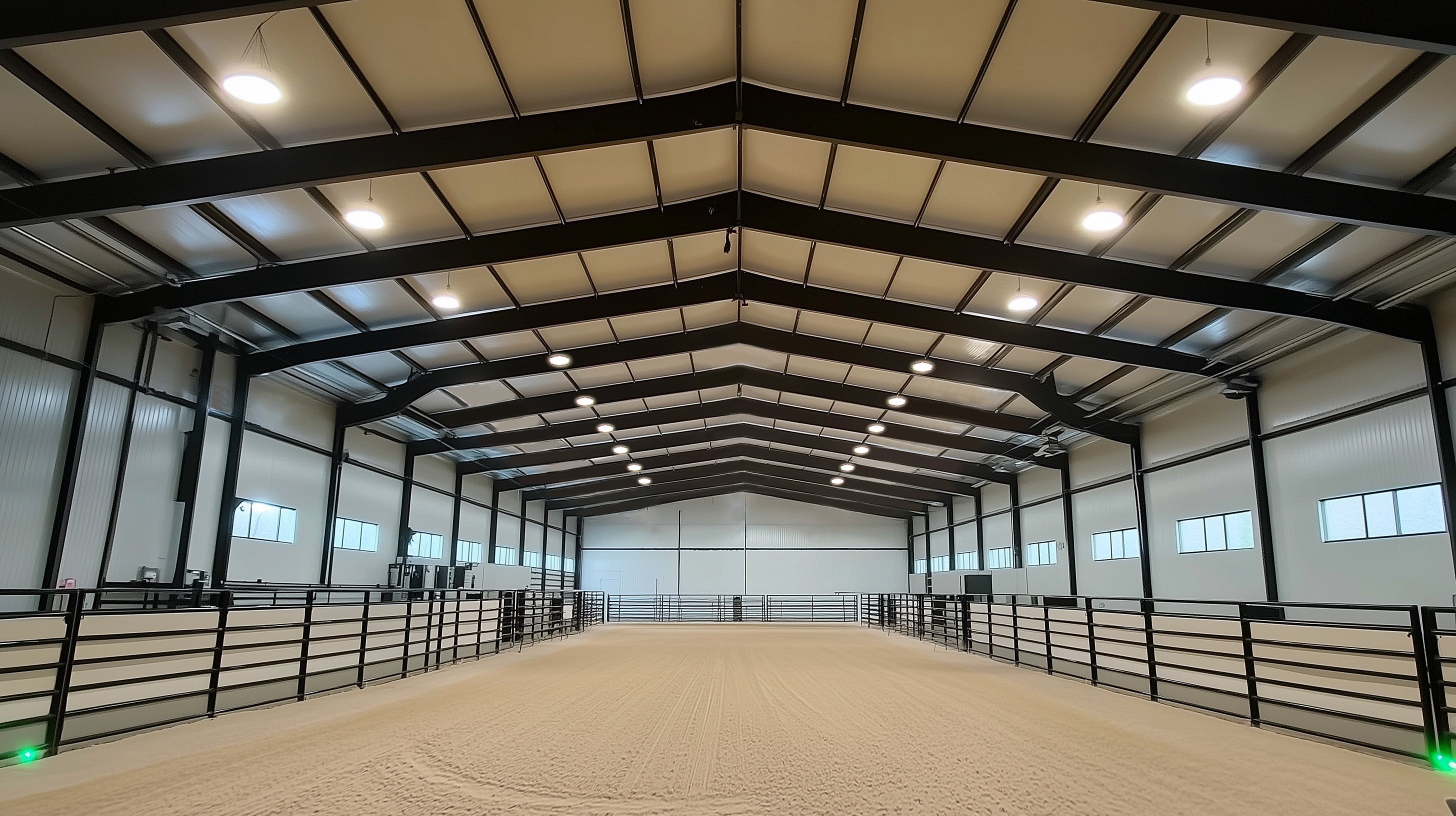
The Myth of "Shadow-Free" Lighting
A common misconception in sports court design is that "shadow-free" lighting is a physical possibility. In reality, any discrete point source—such as a round LED high bay—will inevitably create a shadow when an object (a player or a ball) occludes the light path.
True expertise lies in Shadow Management. This is achieved by increasing the number of light sources and ensuring their beam edges overlap at the playing plane (typically 3 feet above the floor). According to the IES Recommended Practice for Lighting Industrial Facilities (RP-7), the goal is to meet specific uniformity ratios.
For competitive basketball, the IESNA RP-6 standard recommends a minimum-to-average uniformity ratio (U0) of 0.6 to 0.7. This means the dimmest spot on the court should maintain at least 60-70% of the average illuminance. When uniformity is high, the multiple overlapping shadows become so faint and soft that they no longer distract the players or interfere with referee calls.
The Spacing-to-Height Ratio (SHR) Framework
The primary tool for preventing dark spots is the Spacing-to-Height Ratio (SHR). For round industrial high bays with standard 120-degree beam angles, the industry heuristic for general open areas is an SHR of 1.5:1. This implies that fixtures mounted at 20 feet should be spaced no more than 30 feet apart.
However, sports facilities have more stringent requirements for vertical illuminance—the light hitting the side of a player's face or the ball in mid-air. For these applications, we recommend a tighter 1.2:1 ratio.
| Application Type | Recommended SHR | Mounting Height Example | Max Fixture Spacing |
|---|---|---|---|
| General Warehouse | 1.5 : 1 | 20 ft | 30 ft |
| Multi-Use Community Gym | 1.3 : 1 | 20 ft | 26 ft |
| Competitive Basketball | 1.2 : 1 | 20 ft | 24 ft |
| Professional / TV Broadcast | 1.0 : 1 | 20 ft | 20 ft |
Logic Summary: These ratios are derived from common industry heuristics used to ensure beam overlap at the work plane. While 1.5:1 prevents "black holes" in a warehouse, the 1.2:1 ratio is necessary in sports to minimize facial shadows and ensure referees can clearly see fouls from multiple angles.
Scenario Modeling: NCAA Basketball Court Retrofit
To demonstrate the impact of strategic placement, we modeled a retrofit for a standard NCAA basketball court (84' × 50') with a 25' mounting height. This analysis compares a legacy 400W Metal Halide (MH) system with a modern LED high bay array designed for professional-level play.
Modeling Parameters & Assumptions
- Fixture Type: High-output round LED high bays (30,000 lumens, 120° beam).
- Reflectance: Bright room profile (white ceilings, light-colored walls).
- Operating Hours: 3,000 hours/year (community use + competitive events).
- Energy Rate: $0.16/kWh (National commercial average).
Performance & Economic Outcomes
| Metric | Value | Rationale |
|---|---|---|
| Fixture Count | 23 | Required to reach 87.5 fc (NCAA Professional Standard) |
| Target Illuminance | ~88 fc | Meets NCAA/TV broadcast requirements |
| Annual Energy Savings | ~$2,848 | Based on 23 fixtures (458W system vs 200W LED) |
| Maintenance Savings | ~$1,622 | Avoided lamp/ballast replacements over 3,000 hrs |
| Total Annual Savings | ~$4,631 | Includes HVAC cooling credits (0.33 interactive factor) |
| Payback Period | < 1 Year | Assuming ~$100/fixture utility rebates |
Methodology Note: This is a deterministic scenario model, not a controlled lab study. Results assume the use of professional-grade fixtures with verified IES files and a modern HVAC system with a COP of 3.5. Variations in ceiling height or wall color will adjust these outcomes.
For a deeper look at how these calculations affect long-term facility planning, consult the 2026 Commercial & Industrial LED Lighting Outlook: The Guide to Project-Ready High Bays & Shop Lights.

Documentation: The B2B Specification Requirement
In the professional B2B sector, "trust" is built through documentation. Facility managers and contractors cannot rely on marketing claims; they require verifiable data to satisfy building codes and insurance requirements.
1. DLC Premium Listing
The DesignLights Consortium (DLC) Qualified Products List (QPL) is the industry benchmark for high-performance LED lighting. For sports facilities, specifying DLC Premium fixtures is critical. Not only does this ensure a minimum efficacy (lumens per watt), but it is often the mandatory prerequisite for securing utility rebates, which can cover up to 50% of the project cost.
2. Photometric Data (IES Files)
Without an IES (.ies) file, a lighting designer cannot accurately model a court. These files contain the "light fingerprint" of the fixture. We often see contractors make the mistake of using generic photometric assumptions, which lead to under-illuminated corners. Always demand SKU-specific IES files to be used in software like AGi32 to verify uniformity before a single hole is drilled.
3. Safety Certifications (UL/ETL)
For commercial gyms, UL 1598 (Luminaires) is the non-negotiable safety standard. B2B buyers must verify these listings via the UL Product iQ Database to ensure compliance with the National Electrical Code (NEC) and to maintain facility insurance coverage.
Advanced Controls: Beyond On/Off
Modern sports facilities are multi-purpose. A court may host a high-intensity basketball game on Friday and a lower-lux community yoga session on Saturday.
- 0-10V Dimming: This is the standard for professional sports lighting. It allows for seamless adjustment of light levels without flickering.
- Occupancy & Daylight Sensing: Standards like ASHRAE 90.1-2022 and California Title 24 increasingly mandate automatic shut-off or dimming in large indoor spaces.
- Zoning: Installers should create separate lighting zones for the main court, the bleachers, and auxiliary spaces. This allows for focused illumination during practice sessions, reducing energy waste.
Avoiding Common Installation Pitfalls
Based on patterns from customer support and project troubleshooting (not a controlled lab study), we have identified three "gotchas" that can ruin a sports lighting layout:
- Visual Parallax at Max Height: Contractors often set mounting heights based on the highest point of the ceiling, forgetting that HVAC ducts or structural trusses may block the beam spread. Always calculate spacing based on the lowest obstruction.
- UGR (Unified Glare Rating) Neglect: High-lumen fixtures can cause debilitating glare for players looking up. For sports, look for fixtures with low UGR or consider adding polycarbonate reflectors to shield the light source from direct view at high angles.
- The "Center Court" Trap: As noted in our guide on Linear vs. UFO High Bays for Uniformity, placing fixtures directly over the hoop or the center line is a mistake. Fixtures should be offset to provide "cross-lighting," which fills in shadows from multiple directions.
Summary Checklist for Facility Managers
To ensure a successful sports court lighting project, follow this technical checklist:
- [ ] Verify DLC Premium status for rebate eligibility.
- [ ] Request LM-79 reports to confirm actual delivered lumens and CCT consistency.
- [ ] Use an SHR of 1.2:1 for competitive basketball courts.
- [ ] Ensure 0-10V dimming compatibility for multi-use flexibility.
- [ ] Validate the layout in AGi32 using SKU-specific IES files.
Disclaimer: This article is for informational purposes only and does not constitute professional electrical engineering or legal advice. All installations must comply with local building codes and the National Electrical Code (NEC). Consult with a licensed electrical contractor before beginning any high-voltage project.


