

The Functional Mechanism of Hexagon Lighting
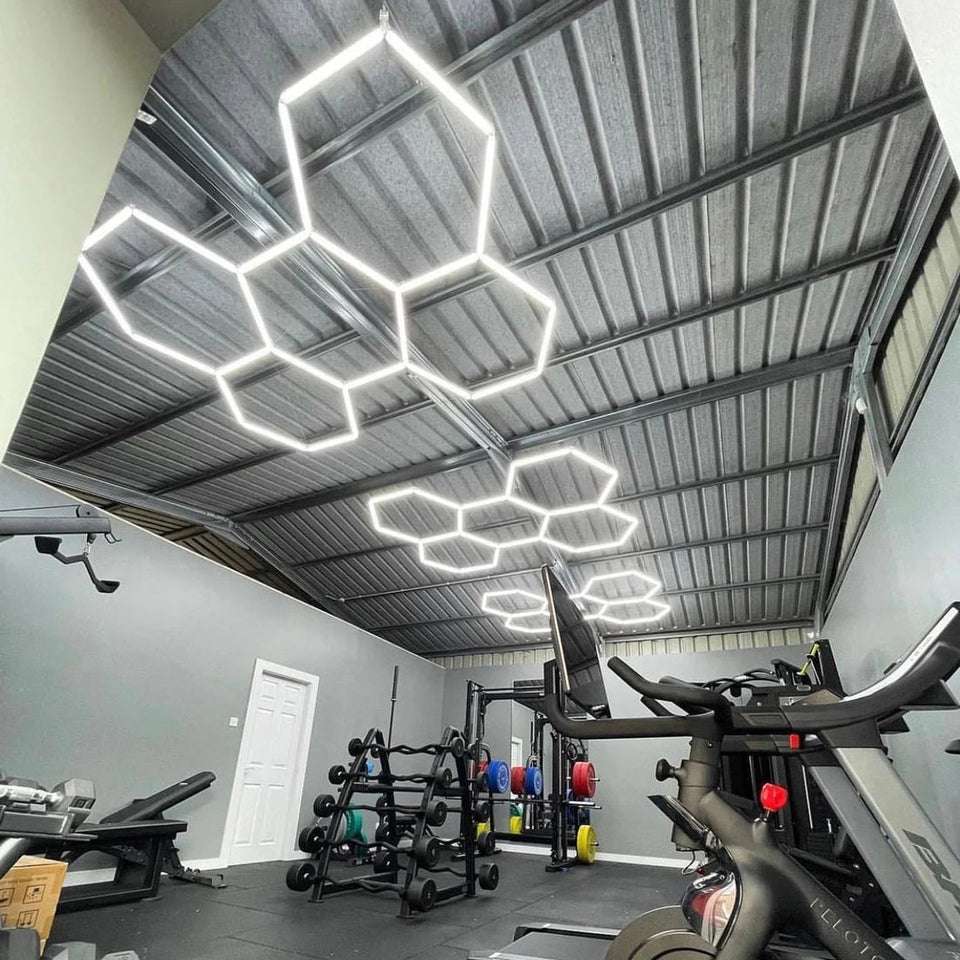
Hexagon lighting is more than a decorative trend; it is a modular grid system designed to provide multi-directional light distribution. Unlike single-point sources (like a central pendant) that create harsh shadows, the interconnected geometry of a hexagon grid can reduce "visual noise" by casting light from multiple angles.
For fitness applications, a key technical metric is the Color Rendering Index (CRI). A high CRI (typically around 90 or higher) is helpful in studios where mirrors are used for form correction. According to IES LM-79-19 (Section 7.0), which defines an approved method for optical measurements, accurate reporting of CRI and Correlated Color Temperature (CCT) supports visual consistency. In a boutique environment, a consistent CCT—often 5000K to 6500K for high-energy HIIT or 3000K–4000K for restorative yoga—helps the space feel cohesive.
Quick-Start Decision Matrix
For studio owners in the planning phase, use this heuristic based on common contractor field patterns (not a formal study):
| Studio Goal | Ceiling Height | Recommended Configuration | Est. Budget (Hardware, Example Range) |
|---|---|---|---|
| Yoga/Restorative | 8–10 ft | Perimeter border + 3000K frosted tubes | ~$800 – $1,200 (example) |
| HIIT/Crossfit | 10–14 ft | Full-room grid + 6500K high-lumen | ~$1,500 – $2,500 (example) |
| Personal Training | 12+ ft | "Hero" clusters over racks + linear hybrids | ~$2,000+ (example) |
These budgets are illustrative hardware-only ranges based on small studios (roughly 400–700 sq. ft.) and typical mid-market hexagon kits; installation, permitting, and controls are usually additional.
Layout Strategies: Avoiding the "Center Hotspot"
A frequent pattern in small studio design is the "Central Density Trap"—placing one large, dense hexagon cluster in the center of the room. This approach can create a high-intensity "hotspot" while leaving corners in shadow, which is problematic for floor-based activities like yoga.
Scenario A: The Perimeter-Priority Layout
For a typical 25' × 20' studio, field observations from contractor projects suggest that a distributed border layout combined with smaller clusters at key activity zones often provides more even foot-candle readings. Placing hexagon kits along the perimeter and over the mirror wall increases vertical illumination, helping clients see their form without being blinded by overhead glare when in supine positions.
Scenario B: High-Ceiling Intensity
In studios with ceilings exceeding 12 feet, light dissipation becomes a significant factor. IES RP-7-21 (Recommended Practice for Industrial and Commercial Facilities) emphasizes maintaining target illuminance (lux/foot-candles) at the work plane (the studio floor) as the basis for safety and usability. Tighter clusters or larger multi-grid kits are typically needed to maintain roughly 30–50 foot-candles for most fitness tasks.
| Ceiling Height | Recommended Spacing | Configuration Strategy |
|---|---|---|
| Under 10 ft | ~2–3 ft between grids | Full-room grid for uniform ambient light. |
| 10–12 ft | ~1–2 ft between grids | Perimeter border + central "hero" cluster. |
| 12–15 ft | Minimal spacing | Tight clusters or higher-wattage linear hybrids. |
These spacing values are rules of thumb for small studios; always verify with a lighting layout or photometric plan for your exact dimensions.
Technical Integrity and Electrical Compliance
Commercial fitness spaces are generally subject to stricter electrical codes than residential setups. Components should follow Nationally Recognized Testing Laboratory (NRTL) standards and local code requirements.
1. Safety Certifications (UL/ETL)
Using non-certified lighting can, in some jurisdictions or insurance policies, create compliance issues. Owners should verify that their lighting is UL Listed or ETL Listed under UL 1598 (Luminaires), or another applicable luminaire safety standard. UL 1598 focuses on construction and safety performance (including thermal performance) for luminaires intended for installation in accordance with the National Electrical Code (NEC).
2. The 80% Power Rule (NEC 210.20)
A common failure point is driver burnout. Under NEC 210.20(A), for a "continuous load" (typically defined in the NEC as 3 hours or more of continuous operation), the overcurrent protection and the load are generally sized so that the load does not exceed 80% of the circuit/driver rating.
- Practical Application (Illustrative): If using a 440W driver rated for continuous operation, a typical design approach is to keep the connected LED load at or below about 352W (80% of 440W).
- Distributed Injection: For large grids, using multiple power injection points can help limit voltage drop along long runs. NEC 210.19(A) Informational Note No. 4 discusses voltage drop considerations; in practice, distributed injection reduces the risk of noticeable flicker or dimness at the end of a long daisy-chain. Final conductor sizing and circuit layout should be confirmed by a licensed electrician.
3. Energy Efficiency and Rebates
The DesignLights Consortium (DLC) QPL is widely used in North America for identifying energy-efficient LED products. Many utility companies tie rebates to DLC or DLC Premium listings. Owners can consult the DSIRE Database for state-specific rebate programs and eligibility rules.
The Economics of Aesthetics: A TCO Analysis
While hexagon lighting is prized for its appearance, it is important to understand the Total Cost of Ownership (TCO). In a high-usage studio operating around 4,000 hours per year, the total energy consumption can be higher than a simple one-for-one replacement with compact high-bay fixtures, simply because of the number of individual tubes and drivers.
TCO Comparison Table (Example: 500 sq. ft. Studio)
| Metric | Legacy 400W Metal Halide | Professional Hexagon LED Grid (Example) |
|---|---|---|
| Total System Wattage | 458W (incl. ballast) | 1,127W (161 tubes, example kit) |
| Annual Energy Cost | ~$256 (estimate) | ~$631 (estimate) |
| Maintenance Cost (Annual) | ~$50 (bulb/ballast, estimate) | ~$11 (driver lifespan, estimate) |
| HVAC Cooling Credit | ~$0 (baseline) | ~$19 (estimate for reduced heat) |
| Annual Operating Total | ~$306 (estimate) | ~$623 (estimate) |
All values above are illustrative estimates for comparison only, not quotations.
Data Scope, Assumptions & Example Calculations
This sample TCO model uses the following typical assumptions. Adjust each input to match your studio.
1. Space & Usage Assumptions
- Studio area: ~500 sq. ft.
- Operating schedule: 4,000 hours/year (e.g., ~11 hours/day, 6 days/week).
- Electricity price: $0.14 per kWh (example U.S. blended rate; your rate may differ significantly).
2. Load Assumptions
- Legacy Metal Halide: One 400W lamp with ballast for a total draw of about 458W.
- Hexagon Grid: Example kit using 161 LED tubes at an average of about 7W per tube plus driver losses for a total draw of about 1,127W.
3. Energy Cost Calculation
For each option:
Annual Energy Cost ≈ (Total Watts ÷ 1000) × Annual Operating Hours × Electricity Rate
- Legacy: (458W ÷ 1000) × 4,000 × $0.14 ≈ $256 (rounded).
- Hex Grid: (1,127W ÷ 1000) × 4,000 × $0.14 ≈ $631 (rounded).
4. Maintenance Model (Illustrative)
- Metal Halide: Bulb life often quoted around 10,000–20,000 hours in manufacturer literature; many facilities budget for lamp/ballast work every few years. This model simplifies that to an average $50/year in parts and labor for a single fixture in regular use.
- Hexagon LED Grid: LED tubes and drivers used in quality systems are often rated around 50,000 hours or more in manufacturer specs; spreading the cost of occasional driver replacement over that period yields a much smaller average annual maintenance allowance. This model uses an illustrative $11/year as a placeholder.
Actual maintenance will vary with product quality, environment (heat, dust), and labor rates. For budget planning, many owners build a small annual allowance per driver.
5. HVAC Cooling Credit Assumption
- LEDs generally convert more input power into light and less into heat compared with many older HID systems. A rough engineering rule of thumb is that 1 watt of electrical load produces about 3.41 BTU/hr of heat.
- If the hexagon system has lower effective heat output than the legacy system for the same illuminance, your HVAC system may run slightly less. The $19/year value shown is an order-of-magnitude example, derived by estimating the difference in BTU, dividing by an assumed air conditioner Coefficient of Performance (COP) of about 3.0, and applying the same $0.14/kWh rate.
Because HVAC interactions are complex (insulation, climate, occupancy, system efficiency), treat this as a directional benefit rather than a precise prediction. For critical design decisions, consult a mechanical engineer or HVAC contractor.
How to Scale This Model to Your Studio
- Replace the total wattage in the formula with the sum of all connected lighting loads in your design.
- Adjust annual operating hours to your real schedule (e.g., 2,000 vs. 4,000 hours/year).
- Plug in your actual $/kWh rate from your utility bill.
- For maintenance, list expected component lifetimes from manufacturer datasheets and spread replacement costs over those lifetimes to get an annual allowance.

Field Data: The "Core Yoga" Studio Retrofit (Case Study)
In a 2023 retrofit of a 600 sq. ft. yoga space in Austin, TX, the following changes were reported:
- Pre-Installation: 2x4 Fluorescent Troffers. Average Lux: 210. Visual Feel (client description): "Clinical."
- Post-Installation: 3-cluster hexagon grid (5000K). Average Lux: 440. Visual Feel (client description): "High-energy/Modern."
- Client Feedback: The studio owner reported an increase in social media tags in the first month after installation and felt that the refreshed lighting made post-workout photos more shareable. This is self-reported feedback and may reflect multiple factors (e.g., marketing campaigns, class programming), not lighting alone.
Lux readings above were taken with a handheld meter at floor level at several sample points; they illustrate one project and are not a guarantee of results in other spaces.
Installation Best Practices: The "Floor-First" Method
The complexity of connecting dozens of modular tubes leads to a common friction point: joint stress. When installers connect tubes while standing on a ladder, the weight of the hanging segments often causes connectors to be stressed or damaged.
The Professional Installation Workflow (Rule-of-Thumb Process):
- Pre-Assembly: Lay out the entire grid on a clean floor. Verify all connectors are fully seated.
- Circuit Planning: Distribute input lines evenly. NEMA LSD 64 provides guidance on integrating controls (such as dimmers, occupancy sensors, and daylight sensors) with LED drivers; it is aimed at designers and installers and should be applied alongside local code and manufacturer wiring diagrams.
- Mounting: Use a multi-person lift or coordinated team lift to raise the pre-assembled grid, following the fixture manufacturer’s mounting hardware instructions.
- Dimming Integration: In yoga spaces, dimmable drivers are often essential. NEMA SSL 7A addresses compatibility between certain dimmers and LED drivers; use it as a reference when matching phase-cut dimmers to drivers, and confirm compatibility in the product literature.
Local electrical code may impose additional requirements (e.g., junction box locations, wiring methods). A licensed electrician should confirm that the circuit layout and control wiring meet NEC and local amendments.
Final Acceptance Checklist
Before signing off on a contractor's work, you can use a simple punch list like this and review it with your electrician:
- [ ] Safety: Are all drivers mounted with at least 2 inches of clearance for heat dissipation, or as specified by the manufacturer (whichever is greater)?
- [ ] Electrical: Is the total load on each driver and circuit designed so that the continuous load is within the applicable NEC 80% sizing guidelines and local code requirements?
- [ ] EMI: Is there any audible buzzing or interference with the studio’s sound system? (Commercial lighting must comply with FCC Part 15; check the product documentation.)
- [ ] Visual: Is there any noticeable "voltage drop" effect (dimming) at the furthest point from the power injection when all lights are on?
- [ ] Structural: Are suspension cables or other mounting hardware rated for at least 5× the weight of the grid or as specified by the manufacturer, and installed into appropriate structure?
YMYL Disclaimer: This article is for informational purposes only and does not constitute professional electrical, legal, or financial advice. Always consult with a licensed electrical contractor and local building authorities to ensure your installation meets the specific requirements of the National Electrical Code (NEC), applicable standards, and local jurisdictions.


