

Executive Summary: The 12-Fixture Standard for 3-Bay Scaling
For a professional 3-bay detailing shop—typically a 60' x 36' footprint—a common pitfall is purchasing one hexagon kit per bay. Technical photometric analysis reveals that a "one kit per bay" approach often fails to meet the 87.5 foot-candle (fc) threshold required for high-end paint correction and inspection. To achieve uniform, shadow-free illumination across three commercial bays with 14-foot ceilings, a 12-fixture grid (4x3 configuration) is the professional benchmark.
This layout ensures a Spacing Criterion (SC) that eliminates dark spots between work zones while maintaining an electrical load that respects the National Electrical Code (NEC) 80% continuous-load rule.
Disclosure: This technical guide is produced by our engineering team to assist shop owners in planning high-performance environments. While we provide specialized lighting hardware, the benchmarks and calculations presented are derived from established IES and NEC standards to ensure objective engineering accuracy.
1. Photometric Planning: Methodology & Simulation Assumptions
In a professional detailing environment, "brightness" is secondary to "uniformity." While the Lumen Method provides a baseline, it often ignores how light falls across the vehicle's vertical surfaces.
How We Calculate: The Simulation Model
To derive the 87.5 fc recommendation for a 2,160 sq. ft. facility (60' x 36'), we utilize the Lumen Method formula. Please note that these figures are modeled estimates based on the following specific parameters:
$$Footcandles (fc) = \frac{Total Lumens \times CU \times LLF}{Area}$$
Simulation Parameters:
- Target: 87.5 fc (IES recommendation for high-precision automotive task areas).
- Fixture Output: ~26,500 lumens per 14-grid fixture (Model-specific).
- Coefficient of Utilization (CU): 0.70 (Assumes high-reflectance white walls and ceilings).
- Light Loss Factor (LLF): 0.85 (Accounting for minor dust accumulation and diode depreciation).
Under these specific conditions, a 12-fixture array provides approximately 318,000 raw lumens, resulting in a calculated average of 87.7 fc. A 9-fixture setup drops this to ~65 fc—sufficient for general mechanical work, but often inadequate for spotting micro-marring on dark clear coats.
The Spacing Criterion (SC) Gap
According to IES RP-7-21 - Lighting Industrial Facilities, uniform horizontal and vertical illuminance is critical for safety. For a 14-foot ceiling, the maximum spacing between modular hexagon units should not exceed 1.25 times the mounting height (approx. 17.5 feet).
- The 9-Fixture Constraint: Spacing frequently exceeds the SC, leading to "light valleys" (darker zones) between the bays where detailers inspect side panels.
- The 12-Fixture Solution: Reduces the gap between light sources, ensuring overlapping light cones provide consistent vertical illumination on vehicle doors and rockers.
Impact of Ceiling Height on Light Falloff
Ceiling height is the most significant variable in shop planning. For ceilings above 12 feet, practitioners must account for the Inverse Square Law.
| Ceiling Height | Lumen Compensation Factor | Recommended Layout Adjustment |
|---|---|---|
| 10 - 12 Feet | 0% (Baseline) | Standard Grid Spacing |
| 12 - 15 Feet | +20% Lumens | Increase Density or Wattage |
| 15 - 20 Feet | +30% Lumens | Suspend Fixtures or Use High-Output Tubes |

2. Detailing-Specific Performance Standards
Professional detailing is a visual audit of paint defects. Standard "shop lights" often mask swirls and holograms due to poor Color Rendering Index (CRI).
CRI and CCT Rigor
For automotive paint correction, a CRI of >90 is recommended. This is verified through IES LM-79-19, which measures the optical and electrical performance of Solid-State Lighting (SSL). High CRI ensures that "true" colors are revealed, reducing the risk of "metamerism"—where paint looks corrected under shop lights but shows defects under natural sunlight.
The Correlated Color Temperature (CCT) should be maintained between 5000K and 6500K. According to the ANSI C78.377-2017 standard, staying within specific chromaticity quadrangles ensures that if you expand your shop later, the new lights will visually match the old ones.
Durability: IP and IK Ratings
Detailing bays are "damp locations." Fixtures should comply with IEC 60529 (IP Ratings). An IP65 rating is recommended to protect against dust and low-pressure water from pressure washers. Additionally, look for an IK08 rating per IEC 62262, certifying the housing can withstand a 5-joule impact from ladders or tools.
3. Electrical Infrastructure & NEC Compliance
Scaling to 12 hexagon kits introduces electrical complexity. A single 14-grid hexagon system can draw approximately 329W to 440W. In a 12-fixture setup, the total load can reach 5,280W.
Step-by-Step Circuit Load Calculation
Per the NFPA 70 - National Electrical Code (NEC), commercial lighting is a continuous load. Therefore, a circuit should only be loaded to 80% of its rated capacity.
Example Calculation for 12 Fixtures (Assuming 400W per kit):
- Total Load: 12 fixtures × 400W = 4,800 Watts.
- 20A Circuit Capacity (120V): 20A × 120V = 2,400 Watts.
- 80% Safety Limit: 2,400W × 0.80 = 1,920 Watts usable per circuit.
- Circuit Requirement: 4,800W ÷ 1,920W = 2.5 Circuits.
- Conclusion: You must round up to three dedicated 20A circuits to avoid breaker trips and heat buildup.
Note: Local building codes and the Authority Having Jurisdiction (AHJ) may require specific variations. Always consult a licensed electrician to verify wire gauge (typically 12 AWG for 20A) for your specific municipality.
Daisy-Chaining Limits
Most professional hexagon kits utilize a 440W maximum limit per power feed. Exceeding 62 tube segments on a single input line can trigger a voltage drop, resulting in flickering or driver failure. In a scaled shop, plan for multiple power injection points (approximately one for every two fixtures) to maintain consistent current.
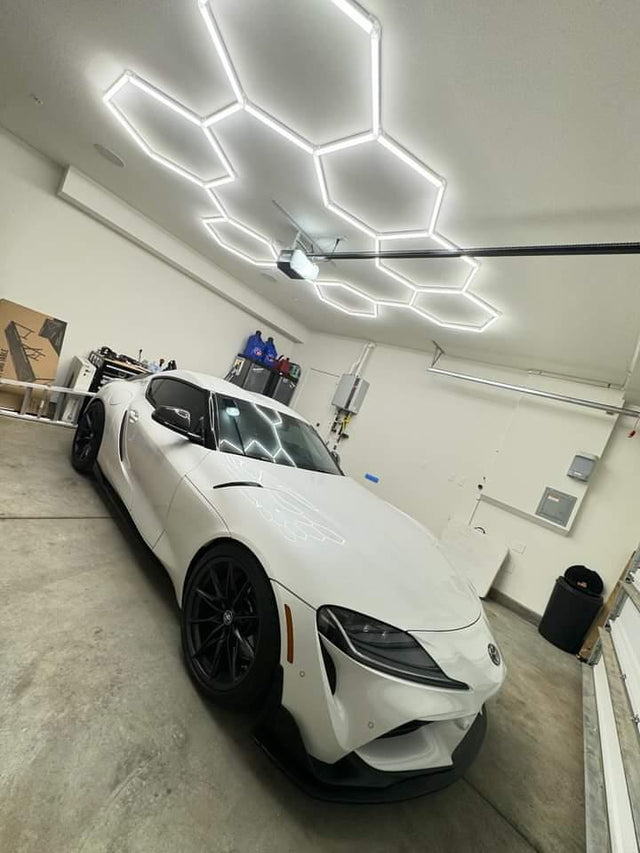
4. Safety Certifications and Risk Mitigation
Installing uncertified lighting can void commercial insurance policies or lead to failed fire inspections.
UL 1598 vs. UL 8750
Every fixture in a commercial shop should be UL Listed.
- UL 1598: The standard for fixed luminaires; ensures housing can handle thermal stress.
- UL 8750: Specifically covers LED drivers and modules. Using certified fixtures ensures the power supply won't interfere with sensitive shop equipment, such as electronic paint thickness gauges, a requirement often reinforced by FCC Part 15 regulations.
5. Economic Justification: Projected ROI & Rebates
Energy and Maintenance Estimates
Based on our 12-fixture simulation, replacing legacy 458W metal halide fixtures with 329W high-efficiency LEDs typically results in:
- Annual Energy Savings: ~$867 (based on 4,000 operating hours at $0.14/kWh).
- Maintenance Avoidance: ~$468 (estimated labor/material for ballast replacement).
- HVAC Credit: ~$45 (reduced heat load).
Utility Rebates
The DesignLights Consortium (DLC) QPL is the gateway to utility rebates. Many companies offer "prescriptive rebates" for DLC Premium certified lighting, ranging from $40 to $100 per fixture. Use the DSIRE Database to find specific state and utility incentives for your zip code.
6. Installation Strategy for Contractors
- Laser Leveling: Use a 360-degree green beam laser. A 1-degree deviation at the start can result in a 6-inch misalignment by the third bay.
- Circuit Segregation: Wire each bay to a separate switch. This allows detailers to de-energize empty bays, complying with ASHRAE 90.1-2022 energy codes.
- Suspension vs. Surface Mount: For ceilings over 14 feet, a cable suspension system is recommended. Bringing the lights down to 10-12 feet increases the foot-candles on the vehicle surface without increasing the fixture count.

Frequently Asked Questions
Quick Summary:
- Count: 12 kits for 3 bays (4 per bay).
- Power: 3 dedicated 20A circuits (following the NEC 80% rule).
- Spec: 5000K-6500K CCT, >90 CRI, IP65 rated.
How many hexagon kits do I need for a standard 3-bay shop? For a professional 60'x36' facility, a 12-fixture grid is the standard. This provides 4 fixtures per bay, ensuring overlapping light patterns that eliminate shadows on vehicle side panels.
Can I run all the lights on one switch? While possible with a heavy-duty relay, it is not recommended. Following the NEC 80% rule, 12 fixtures will likely exceed the capacity of a single 20A circuit. Splitting the load across three circuits is the safer, code-compliant approach.
What is the best color temperature for detailing? 5000K to 6500K is ideal. 5000K provides a "pure white" comfortable for long sessions, while 6500K mimics overcast daylight, excellent for spotting fine scratches.
Do these lights require a special dimmer? If using dimmable versions, 0-10V dimming protocols are standard for commercial LEDs. Residential triac dimmers often cause flicker and can damage commercial drivers.
Disclaimer: This article is for informational purposes only and does not constitute professional electrical or engineering advice. All electrical installations must be performed by a licensed electrician in accordance with local building codes and the National Electrical Code (NEC). Site-specific photometric requirements may vary based on wall reflectance and specific task needs.
Sources
- DesignLights Consortium (DLC) Qualified Products List
- IES LM-79-19 Standard for Solid-State Lighting
- UL Product iQ Database for Safety Certifications
- DSIRE - Database of State Incentives for Renewables & Efficiency
- ASHRAE Standard 90.1-2022 Energy Standards
- IES RP-7-21 Recommended Practice for Industrial Lighting


