

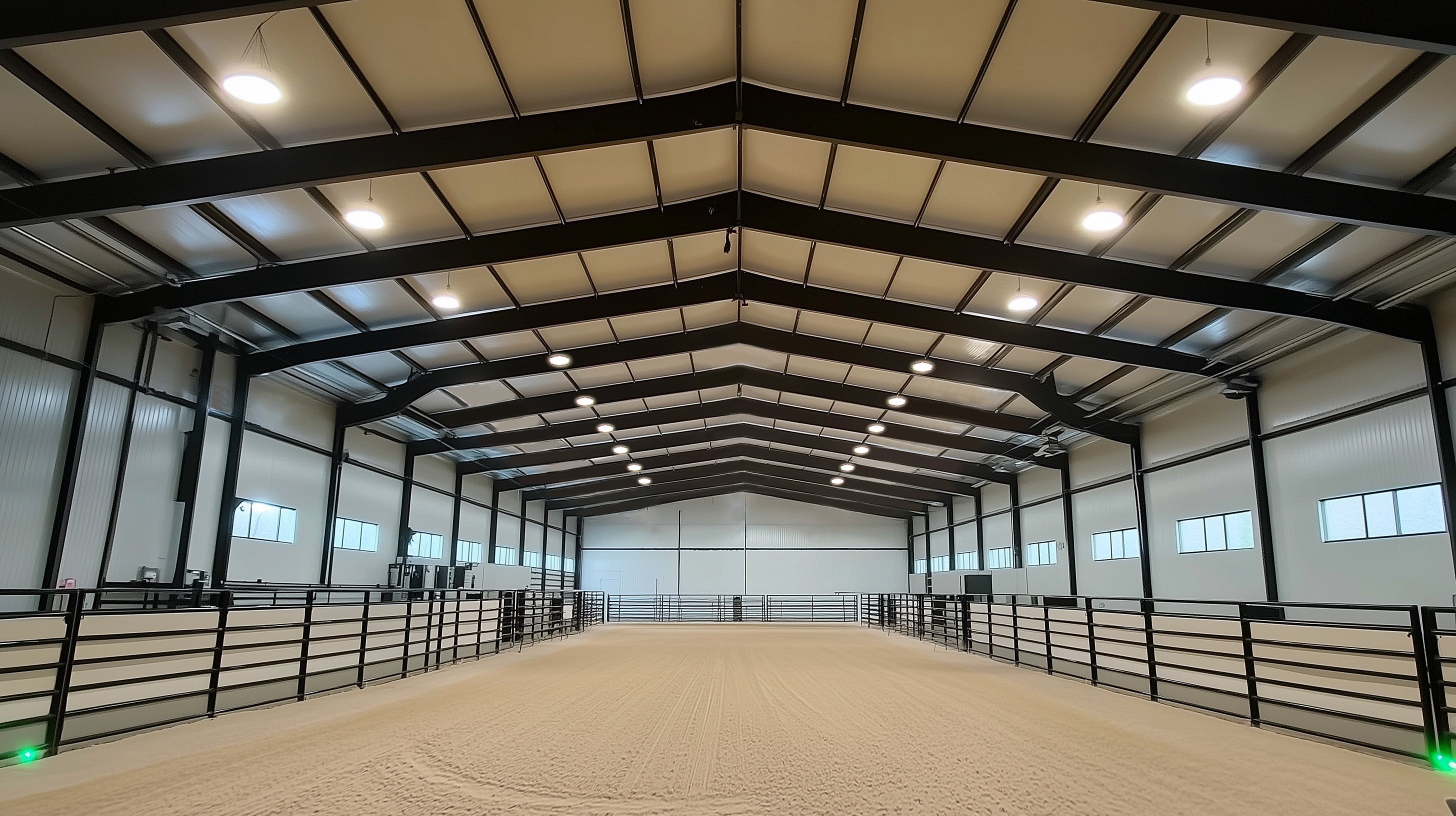
For anyone who has ever performed a heavy set of bench presses under industrial lighting, the problem is visceral. You lie back, unrack the bar, and are immediately met with a blinding, high-intensity point source of light that creates "after-images" and disrupts your focus. In a high-ceiling warehouse, these fixtures—commonly known as UFO high bays due to their circular profile—are efficient workhorses. In a multi-purpose home gym or a small commercial facility with ceilings between 12 and 20 feet, they can become a liability if not properly managed.
Visual comfort is not just an aesthetic preference; it is a safety requirement. According to the IES RP-7-21 (Lighting Industrial Facilities), managing glare is critical to maintaining visibility and reducing worker fatigue. In a gym environment, where "workers" are athletes moving heavy weights in supine positions, the stakes are even higher.
This guide provides a pragmatic framework for gym owners to transition from "utility-grade" to "performance-grade" lighting by controlling glare through optics, placement, and control systems.
The Science of Discomfort: Understanding UGR
To solve glare, we must first measure it. The industry standard is the Unified Glare Rating (UGR), a metric defined by the International Commission on Illumination (CIE) to predict the likelihood of discomfort glare in indoor environments.
The UGR scale typically ranges from 10 to 30. According to technical documentation from LSI Corp, a UGR value of 19 or lower is the generally accepted limit for office-like environments where visual comfort is paramount. For a gym where users frequently look directly at the ceiling, staying as close to the lower end of the effective range (16–28) is ideal.
| UGR Value | Perception | Typical Application |
|---|---|---|
| < 16 | Imperceptible glare | High-end architectural spaces |
| 19 | Acceptable limit | Offices, schools, training centers |
| 22 | Noticeable discomfort | General retail, light manufacturing |
| 25+ | Significant glare | Heavy industrial, high-bay warehouses |
The challenge with UFO high bays is their design. Most standard fixtures utilize a 120-degree beam angle to maximize coverage. While this is excellent for uniformity in open areas, it places the light source directly in the peripheral vision of anyone within a wide radius.
Optical Solutions: Diffusers and Lens Selection
The most immediate way to mitigate glare is to modify the light's exit point. A standard UFO high bay often uses a clear polycarbonate (PC) cover. While this provides maximum lumen output, it does nothing to break up the intensity of the LED chips.
Prismatic vs. Frosted Diffusers
We have observed that a textured prismatic diffuser is significantly more effective for gym applications than a simple frosted cover. A frosted cover acts as a "filter," often merely dimming the light while leaving a bright "hot spot" in the center. In contrast, a prismatic diffuser uses geometric patterns to refract light in multiple directions, effectively breaking the single, intense source into thousands of smaller, lower-intensity points.
The Trade-off: Lumen Depreciation When adding a high-quality prismatic diffuser, you must factor in a 10% to 15% reduction in delivered foot-candles. This occurs because the material absorbs and scatters some of the light. For a fixture like a 150W high bay delivering 21,000 lumens, you may see an effective output of approximately 18,000 lumens after diffusion. This must be accounted for during your initial lumens calculation.
Beam Angle Management
While a 120-degree beam is standard, some specialized optics offer 60-degree or 90-degree flood angles. These narrower angles focus light downward, reducing the "spill" light that hits the eye at high angles. However, in a gym with 12-foot ceilings, a 60-degree beam can create a "spotlight" effect with dark corners. For most multi-purpose spaces, we recommend sticking with a 110-120 degree beam but utilizing a diffuser to soften the delivery.

Strategic Placement: The 45-Degree Rule
Even the best optics cannot fully compensate for poor placement. The most common mistake in garage gym design is mounting a high bay directly over the center of a power rack or bench press station.
The Pattern of Discomfort When you are on a bench, your primary sightline is vertical. If a fixture is within 15 degrees of that vertical axis, the luminance (brightness of the source) will exceed the eye's ability to adapt.
The Solution: Offset Mounting Experienced installers utilize a simple rule of thumb: offset fixtures by at least a 45-degree angle from the primary sightline of any seated or supine position.
- Identify the "Hot Zones": Mark the floor where the bench press and floor-work mats will be located.
- Project Upward: Do not place fixtures in the ceiling area directly above these marks.
- Lateral Distribution: Place fixtures in the "aisles" or between stations. By using the wide 120-degree beam angle of the UFO high bay, the light will still reach the workout station from the side, providing excellent task visibility without the direct vertical glare.
Control Systems: Dimming and Zoning
A gym is often a multi-purpose space. A garage might serve as a vehicle workshop during the day and a gym in the evening. These activities have different lighting requirements.
The 0-10V Dimming Advantage
Modern professional-grade high bays include 0-10V dimming as a standard feature. This is not the same as the "triac" dimming used for household light bulbs. 0-10V dimming uses a dedicated low-voltage circuit to communicate with the LED driver, allowing for smooth, flicker-free adjustment from 100% down to 10%.
According to the NEMA LSD 64-2012 (Lighting Controls Terminology), this type of control is essential for energy efficiency and task-specific tuning. In a gym, we recommend creating two "scenes" via a wall-mounted 0-10V dimmer:
- High-Output Scene (100%): For general cleaning, equipment maintenance, or mechanic task lighting.
- Workout Scene (60-70%): Dimming the lights slightly reduces the source luminance significantly, often bringing a UGR 22 space down to a comfortable UGR 18-19 range without making the room feel "dark."
The Financial Case: ROI and Rebates
For small commercial gym owners, glare control is not just a safety feature—it's an investment with a measurable return. By selecting high-efficiency, DLC Premium certified fixtures with integrated controls, you unlock significant utility incentives.
Theoretical Simulation: Small Commercial Gym Upgrade Facility Size: 2,000 sq. ft. | Fixtures: 8x 150W LED UFO High Bays | Usage: 4,000 hrs/year
| Financial Metric | Estimated Value |
|---|---|
| Utility Rebate Potential | $732 – $1,400 |
| Annual Energy Savings | $1,380 |
| Maintenance Savings (Avoided Relamping) | $312 |
| Total Annual Savings | $1,763 |
| Net Payback Period (After Rebates) | ~5 Months |
Note: Calculations are estimates based on average U.S. commercial electricity rates ($0.14/kWh) and typical utility rebate structures for DLC 5.1 Premium fixtures with controls. Individual results will vary based on local utility programs and DSIRE database listings.
This data demonstrates that the "Value-Pro" approach—investing in certified fixtures with proper controls—effectively pays for itself within the first year. The rebates often cover the additional cost of diffusers and dimming switches, making the professional solution cost-neutral compared to a "budget" LED swap.
Compliance and Quality Assurance
When purchasing lighting for a space where people will be exerting themselves, "unbranded" or uncertified products pose a risk. Electrical safety and performance consistency are non-negotiable.
- Safety Certifications: Ensure fixtures are UL Listed or ETL Listed. This proves the product has been tested to meet North American safety standards (such as UL 1598 for luminaires). You can verify these certificates via the UL Product iQ Database.
- Performance Reporting: Look for an IES LM-79 report. This is the "performance report card" for an LED light. It verifies that the lumens, efficacy (lm/W), and color temperature (CCT) claimed on the box are accurate. As noted in the 2026 Commercial & Industrial LED Lighting Outlook, project-ready fixtures must provide these reports to ensure they meet the rigorous demands of commercial environments.
- Electromagnetic Interference (EMI): Cheap LED drivers can interfere with Wi-Fi signals or heart-rate monitors. Ensure your fixtures are FCC Part 15 compliant to prevent non-intentional radio frequency interference.
Installation Checklist for Gym Owners
To ensure your gym lighting project succeeds, follow this technical checklist:
- Step 1: Height Assessment. For ceilings under 12 feet, consider linear high bays or UFOs with heavy diffusion. For 12-20 feet, UFO high bays are ideal.
- Step 2: Photometric Planning. Use a lighting layout tool to ensure uniform foot-candles across the floor. Aim for 30-50 foot-candles for general exercise and 50-70 for high-detail areas like a repair bench.
- Step 3: Circuit Management. Ensure your lighting circuit is separate from high-draw equipment like treadmills to prevent flickering.
- Step 4: Safety Tethering. Always use the provided safety cable in addition to the primary hook mount. In a gym, vibrations from music or heavy drops can loosen mechanical fasteners over time.
- Step 5: Wiring Compliance. Follow the National Electrical Code (NEC) for all wiring. If you are using 0-10V dimming, ensure the low-voltage wires are properly separated from the high-voltage lines according to Class 1 or Class 2 wiring rules.
Optimizing the Athlete Experience
The transition from a "bright garage" to a "professional training environment" hinges on the management of light quality. By prioritizing UGR targets, utilizing prismatic diffusers, and adhering to the 45-degree offset rule, you create a space that supports peak performance rather than hindering it.
Whether you are a DIYer building a dream home gym or a small business owner looking to reduce overhead while improving member experience, the "Value-Pro" strategy—balancing technical compliance with practical installation—is the most reliable path to success.
YMYL Disclaimer: This article is for informational purposes only and does not constitute professional electrical, structural, or fitness safety advice. Always consult with a licensed electrician for installation and a qualified fitness professional regarding gym equipment layout. Improperly installed lighting or equipment can result in injury.
References
- IES RP-7-21: Recommended Practice for Lighting Industrial Facilities
- LSI Corp: Unified Glare Rating (UGR) FAQs
- DesignLights Consortium (DLC) Qualified Products List
- NEMA LSD 64-2012: Lighting Controls Terminology
- ASHRAE Standard 90.1: Energy Standard for Buildings
- IES LM-79-19: Optical and Electrical Measurements of Solid-State Lighting
- National Electrical Code (NEC) Overview


