

Eliminate Shadows: UFO vs. Linear vs. Hex Fixtures
In any precision environment—whether a commercial auto repair bay or a high-end home workshop—shadows are more than a nuisance; they are a safety hazard and a barrier to quality. The "best" fixture is not defined by its lumen output alone, but by its ability to distribute light uniformly across the workplane while minimizing the dark zones created by equipment, vehicles, and the human body.
The Professional Verdict: For ceilings exceeding 20 feet (6 meters), UFO-style high bays are the industry standard due to their concentrated downward punch, provided they follow a strict 1.5:1 spacing-to-mounting height ratio. For aisle-heavy storage or long workbenches, linear high bays with "batwing" distribution are superior for eliminating the "canyon effect" shadows. For residential garages and detailing bays under 15 feet (4.5 meters), hexagon modular systems provide the most uniform ambient fill, though they lack the intensity required for high-bay industrial tasks.
The Physics of Shadowing and Beam Distribution
Shadows occur when a light source is obstructed. In a workshop, this typically happens when a technician leans over an engine bay or when a lift-mounted vehicle blocks overhead light. To mitigate this, we look at the Fixture's Photometric Distribution, often detailed in an IES (Illuminating Engineering Society) file.
- Point Sources (UFO): These act as high-intensity single points. If spaced too far apart, they create sharp, high-contrast shadows.
- Linear Sources: These spread light along a longitudinal axis. They are highly effective at "filling" shadows from one side, particularly useful in narrow aisles.
- Surface/Grid Sources (Hexagon): By distributing many low-intensity points across a wide area, these fixtures create "overlapping" light that fills in shadows from multiple angles simultaneously.
According to the IES LM-79-19 standard, which defines the electrical and photometric measurements of solid-state lighting, the total luminous flux and distribution must be verified to ensure the fixture performs as advertised. For professional contractors, checking the LM-79 report is the first step in verifying a fixture's shadow-reduction potential.
UFO High Bays: The High-Ceiling Powerhouse
UFO high bays are designed for "punch." In facilities with 20-foot to 40-foot ceilings, the goal is to drive light through the "air gap" to reach the floor with enough foot-candles (fc) for safe operation.
The 1.5x Spacing Rule
A common mistake in facility management is under-spacing fixtures to save on initial costs. Based on our observations from contractor feedback and layout simulations, the universal rule for uniform lighting is that fixture spacing should not exceed 1.5 times the mounting height.
- Example: If your fixtures are mounted at 20 feet, they should be spaced no more than 30 feet apart.
- The Risk: Exceeding this ratio creates "dark spots" or "scalloping" between fixtures, where light levels drop significantly, leading to high-contrast shadows that cause eye fatigue.
Glare and UGR Compliance
In sports gyms or workshops where technicians look upward, glare becomes a factor. While many assume UFOs are inherently high-glare, the DesignLights Consortium (DLC) Qualified Products List (QPL) now includes 5.1 Premium standards that evaluate Unified Glare Rating (UGR). A UFO fixture with a prismatic refractor or micro-lens optic can achieve a UGR < 22, making it comfortable for long-shift environments.

Linear High Bays: Eliminating the "Canyon Effect"
In warehouses with tall racking or shops with long, fixed workbenches, linear fixtures are mathematically superior. They utilize a "batwing" distribution, which throws light out at wider angles to the sides rather than just straight down.
Aisle Optimization
When lighting an aisle, a UFO fixture creates a "hot spot" directly beneath it and deep shadows between the racks (the canyon effect). Linear fixtures, mounted parallel to the aisle, provide continuous overlapping coverage. According to the IES RP-7-21 Recommended Practice for Industrial Facilities, achieving vertical illuminance on rack faces is critical for safety. Linear fixtures achieve this more efficiently by distributing the source over a 4-foot or 8-foot length.
Task Uniformity
For detailed mechanical work, lighting designers aim for a uniformity ratio (maximum to minimum illuminance) of no more than 3:1 on the workplane. Linear fixtures, when placed directly over a bench, achieve this ratio more easily than point-source UFOs, which may require twice as many fixtures to reach the same level of evenness.

Hexagon Systems: The Detailing and Low-Ceiling King
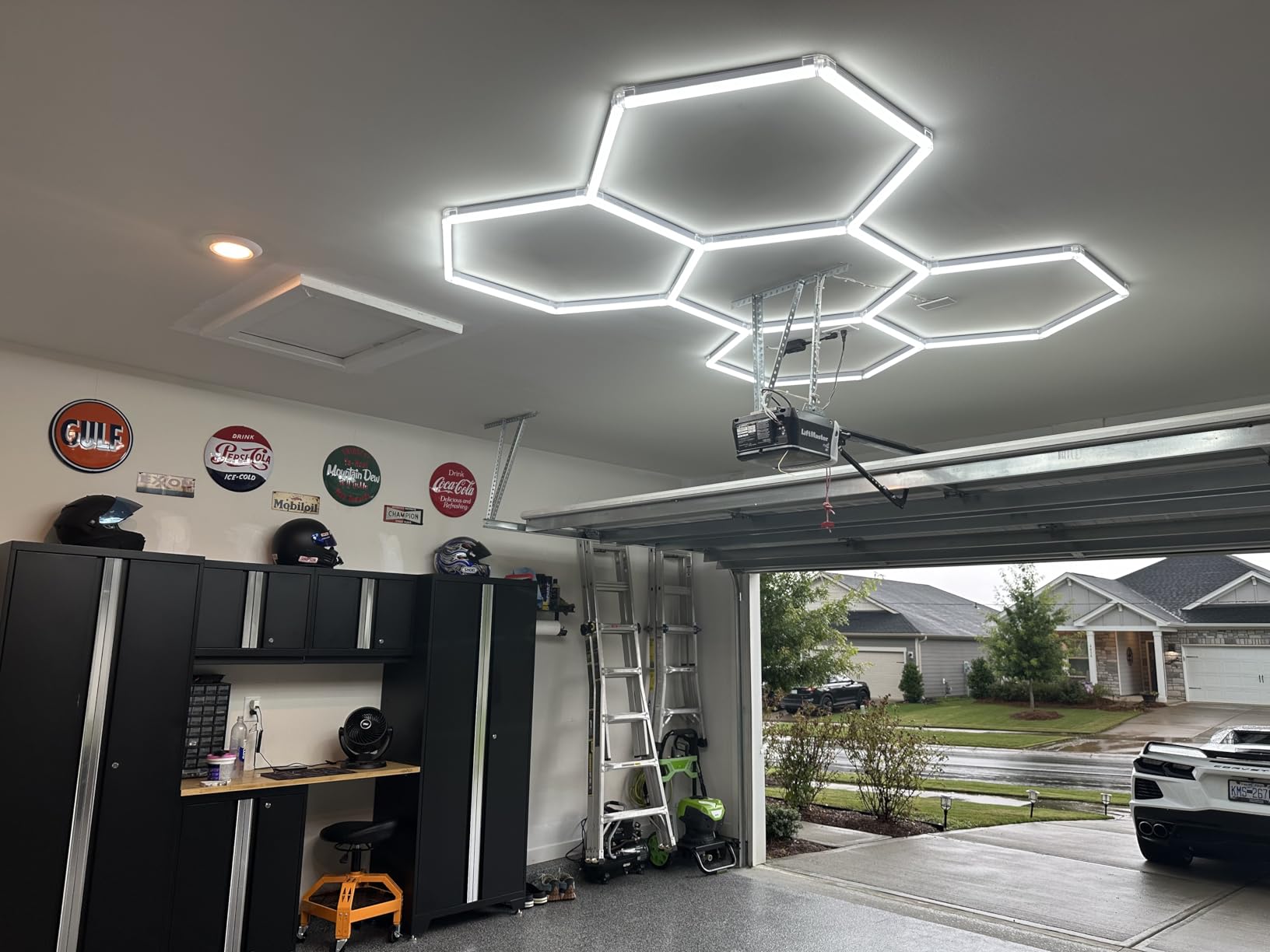
Hexagon lighting has moved from a "trend" to a functional staple in car detailing and home workshops. Their strength lies in multi-directional overlapping.
Why Detailing Shops Prefer Hex
In car detailing, "swirl marks" and paint imperfections are only visible under specific light angles. A hexagon grid places light sources at 120-degree angles relative to each other. This means that as a detailer moves around a vehicle, light is always hitting the surface from multiple directions, virtually eliminating the shadows cast by the detailer's own body.
The 15-Foot Limit
While aesthetically striking, hexagon systems are typically constructed from lightweight polycarbonate and use lower-wattage LED strips. Our scenario modeling indicates that these systems are not suitable for primary illumination in spaces with ceilings over 15 feet. At higher altitudes, the light diffuses too much, failing to provide the 50+ foot-candles required for mechanical work.
Logic Summary: For residential garages (10–12ft ceilings), a hexagon system provides ~30–40fc of ambient light, which is excellent for general use but may need supplemental linear task lighting over workbenches.

Methodology: How We Model Lighting Performance
To provide pragmatic advice, we modeled a standard commercial auto repair facility in California. This allows us to move beyond "marketing lumens" and into real-world operational impact.
Modeling Note (Reproducible Parameters)
Our analysis assumes a deterministic parameterized model for a high-volume service bay.
| Parameter | Value | Unit | Rationale / Source |
|---|---|---|---|
| Mounting Height | 22 | ft | Typical for commercial lift clearance |
| Target Illuminance | 50 | fc | IES recommendation for engine service |
| Electricity Rate | 0.18 | $/kWh | California commercial average |
| Analysis Horizon | 10 | years | Standard ROI period for facility upgrades |
| Reflector Type | Prismatic | N/A | Selected for UGR < 22 compliance |
Quantitative Insights from Modeling
- Total Cost of Ownership (TCO): Upgrading from 400W metal halide (which draws ~458W with ballast) to 240W LED UFO fixtures results in an annual energy saving of ~$2,578 for a 15-fixture shop.
- Payback Period: When factoring in utility rebates (verified via the DSIRE Database), the payback period for this upgrade is approximately 10.5 months.
- Uniformity Check: In a 60x40ft bay, 6 UFO fixtures (37,200 lumens each) achieve a 40fc average. However, the model suggests 8 fixtures at a lower wattage would improve the uniformity ratio from 4:1 to 2.5:1, significantly reducing technician eye strain.
Compliance and Safety Standards
Professional installations must adhere to more than just "brightness." Electrical and energy codes dictate the legality and insurability of your project.
- UL 1598 & UL 8750: All fixtures must be UL Listed or ETL equivalent. UL 1598 covers the luminaire's general safety, while UL 8750 specifically addresses the LED driver and modules. Using non-certified fixtures can void commercial insurance policies in the event of a fire.
- ASHRAE 90.1-2022: This energy standard, often adopted into state building codes, limits Lighting Power Density (LPD). High-efficiency fixtures (140+ lumens per watt) are required to meet these stringent watts-per-square-foot limits.
- FCC Part 15: Lower-quality LED drivers can emit electromagnetic interference (EMI) that disrupts Wi-Fi, radios, or sensitive diagnostic equipment. Always verify FCC Part 15 compliance to ensure shop operations remain uninterrupted.
For a deeper look at the shifting regulatory landscape, refer to the 2026 Commercial & Industrial LED Lighting Outlook: The Guide to Project-Ready High Bays & Shop Lights.
Final Technical Recommendations
Choosing the right fixture requires matching the beam pattern to your specific workflow.
- For Open Service Bays (20ft+): Stick with UFO high bays. Ensure they are DLC Premium listed to maximize your utility rebate. Use a layout tool to verify your S/MH ratio is under 1.5.
- For Narrow Aisles or Long Benches: Deploy Linear high bays. Their elongated source reduces the "shadow overlap" issues common with round fixtures in tight spaces.
- For Detailing and Low-Ceiling Aesthetics: Utilize Hexagon systems. They provide a "shadow-less" environment that is ideal for surface inspection, but be prepared to add task lighting if your ceiling exceeds 15 feet.
- Always Request IES Files: Before a large purchase, ask the manufacturer for .ies files. These can be imported into free software like AGi32 or simple online calculators to predict exactly where shadows will fall before you drill a single hole.
Frequently Asked Questions
Can I mix UFO and Linear fixtures in the same shop? Yes. In fact, many high-end shops use UFOs for general bay lighting and Linear fixtures specifically over workbenches. This "hybrid" approach is often the most effective way to eliminate shadows in multi-use spaces.
What is the difference between UL Listed and UL Recognized? UL Listed means the entire fixture is safe for standalone installation. UL Recognized means a component (like the driver) is safe but must be part of a larger, certified system. For shop owners, always look for the UL Listed mark on the final product.
Why does my LED light flicker on camera? This is often due to a low-quality driver with high "ripple current." Professional-grade fixtures are designed to be "flicker-free," which is essential for shops that film content or use high-speed diagnostic cameras.
How do I find out if my project qualifies for a rebate? Check the DLC QPL to see if your fixture is listed. Then, use the DSIRE Database or your local utility company’s "Business Rebate" page. Many utilities offer between $40 and $100 per fixture for LED retrofits.
Disclaimer: This article is for informational purposes only and does not constitute professional electrical or structural engineering advice. Always consult with a licensed electrician and adhere to local building codes (NFPA 70/NEC) before performing any electrical installations.


