

Can’t decide between a 150W and a 240W UFO high bay? This guide walks through where each size actually makes sense, using real lumen packages, mounting height limits, and simple layout math so you can make a project-ready decision.
The Bottom Line: 150W vs 240W UFO High Bay
If you only remember one thing, use this:
- 150W UFO high bay: Sweet spot for 18–24 ft ceilings, general warehouse and shop lighting at 75–200 lux.
- 240W UFO high bay: Workhorse for 25–35 ft ceilings or whenever you need 200–300+ lux over racks, production lines, or sports courts.
Modern DLC-style wattage-selectable UFOs have changed the gap between these two sizes. Typical current models deliver roughly:
- 150W package: ≈ 24,000 lm
- 240W package: ≈ 38,000 lm
Analysis of recent wattage/CCT-selectable UFOs shows this ≈1.6× lumen ratio, not the older ≈1.3× rule of thumb many designers still use, so any sizing or ROI math based on the old ratio usually underestimates the impact of 240W fixtures.
In practice, that means a 240W unit can often replace 1.3–1.5 of your 150W fixtures at higher mounting heights, which changes both cost and energy calculations.
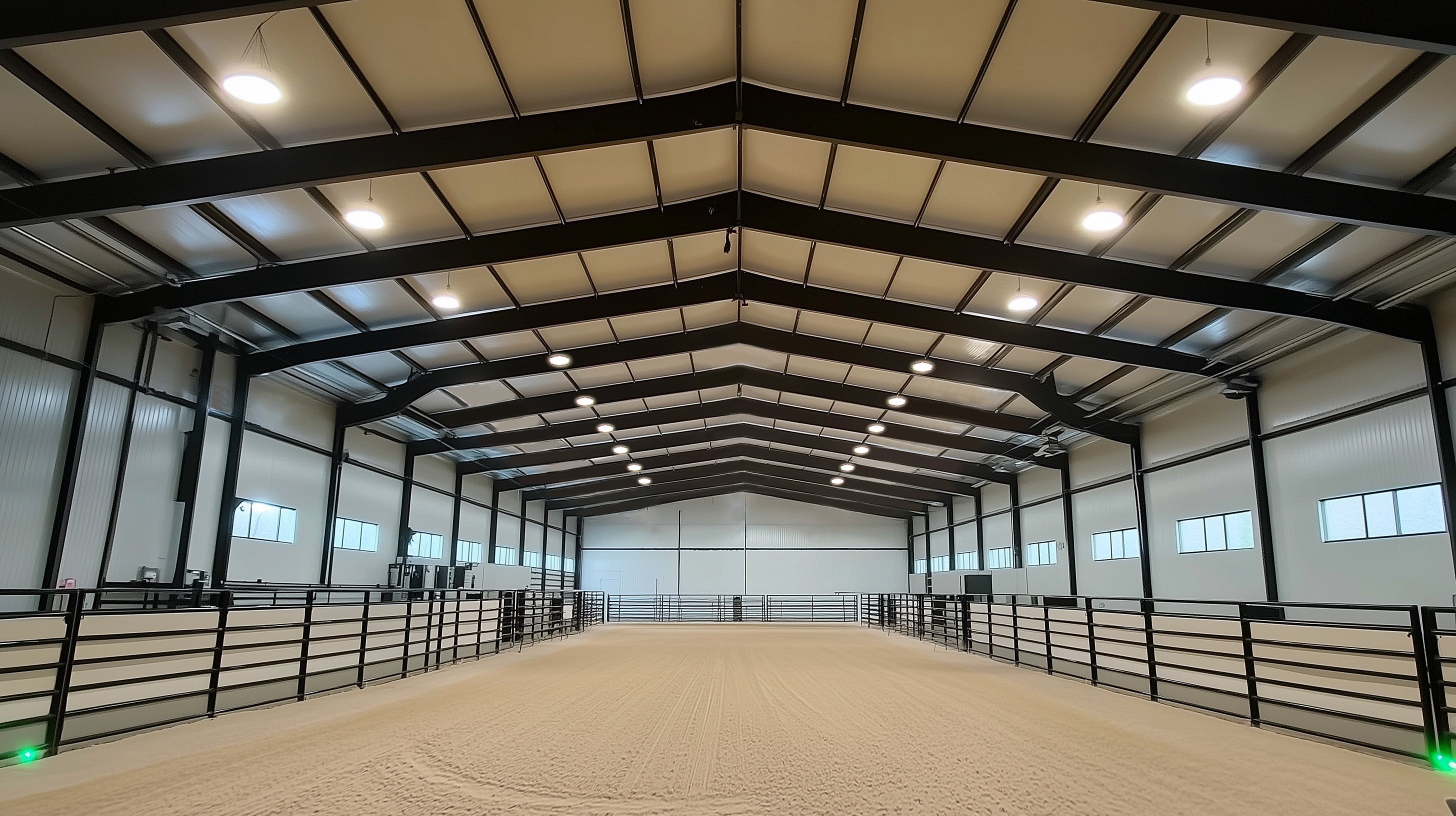
How Wattage, Lumens, and Mounting Height Work Together
Rated vs delivered lumens
For both 150W and 240W UFO high bays, catalogs usually quote rated lumens (LED package output) and an efficacy figure (e.g., 140 lm/W). Real projects care about delivered lumens—what makes it to the workplane after optics, driver losses, and dirt.
From field experience with high bays:
- Optics and diffusers can cut 10–20% of the raw LED output.
- Driver and thermal losses take a few more percent.
- Dirt and aging add another 5–10% over time.
A conservative rule for quick sizing is to assume 0.75–0.9× of rated lumens will be available on the floor after some years in service. If a 240W unit is listed at 38,000 lm, treat it as ~30,000–34,000 delivered lumens when you size.
Why mounting height dominates the choice
Two fixtures with the same lumen output behave very differently at 16 ft vs 30 ft. As mounting height climbs:
- The light spreads out over a larger area.
- The beam gets narrower (relative to the floor) to keep illuminance up.
- Required lumens per fixture rise non-linearly if you want the same lux.
The ANSI/IES RP‑7 recommended practice for industrial facilities gives target illuminance ranges—for example, around 75–150 lux for basic storage and higher values for detail work. At 30 ft, hitting those levels with 150W units alone usually means too many fixtures and too tight spacing. That is where 240W wins.
Practical lux targets
For fast decisions, these are typical working ranges that align well with industrial guidance:
- General warehouse aisles: 75–150 lux on floor.
- Packing / assembly / shops: 200–300 lux on benches or floor.
- Inspection or fine work: 300–500 lux at task plane.
- Garages / DIY shops: 200–400 lux depending on tasks.
These targets are sufficient for most contractor submittals; for large or regulated projects, photometric layouts using IES (.ies) files are expected. The IES LM‑63 format defines how those photometric files are structured, enabling accurate layouts in tools like AGi32.
Quick Comparison: 150W vs 240W UFO High Bay
Use this table as a starting point when you are choosing between 150W and 240W UFO high bays.
| Parameter | 150W UFO High Bay | 240W UFO High Bay |
|---|---|---|
| Typical rated lumens | ≈ 22,000–26,000 lm | ≈ 34,000–40,000 lm |
| Typical efficacy band | 135–150 lm/W (DLC‑oriented) | 135–150 lm/W (DLC‑oriented) |
| Ideal mounting height | ~18–24 ft | ~25–35 ft |
| Typical S/M ratio (wide beam ≈120°) | 0.7–1.0 | 0.8–1.2 |
| Typical target applications | Shops, low/medium warehouses, garages | Tall warehouses, racking, arenas, sports, tall production bays |
| Pros | Lower glare in low ceilings, easier on DIY installs, lower demand load | Fewer fixtures in tall bays, better lux at floor, lower lifetime lift work |
| Cons | Requires dense grids in tall spaces; can under-light detailed tasks | Can create glare in low ceilings; higher per‑fixture power draw |
S/M ratio stands for spacing-to-mounting-height. For example, S/M = 1.0 at 24 ft means about 24 ft spacing between rows or fixtures.
Sizing Framework: When to Choose 150W or 240W
Step 1 – Fix the mounting height
Start with real mounting height, not room height. Subtract any overhead obstructions or truss depth.
- ≤15 ft: Avoid both 150W and 240W in wide-open spaces; 100–120W wide-beam high bays usually give better comfort.
- 18–24 ft: 150W is generally the workhorse for general lighting; 240W is used only for high-lux tasks.
- 25–35 ft: 240W becomes the primary choice; 150W gets relegated to perimeters or low-importance zones.
This matches field observations: once you pass ≈25–30 ft or need 30–50 footcandles (≈ 300–500 lux) on tasks, a smaller number of 240W fixtures often beats dense grids of 150W for both performance and long-term labor cost.
Step 2 – Define your lux target by area
Split the space into zones:
- Storage only: lower lux.
- Active aisles: mid lux.
- Workstations / machinery: higher lux.
Industrial guidance such as ANSI/IES RP‑7 and DOE case studies on efficient lighting show that tailoring levels by zone, not averaging the whole space, produces better safety and energy performance. Do not design everything around the “worst-case” task.
Step 3 – Apply spacing heuristics
For wide-beam UFO high bays (~120° beam):
- General open area: S/M ≈ 0.7–1.0.
- Racking or narrow aisles: S/M ≈ 0.5–0.8 across aisles.
Example: at 24 ft mounting height with S/M = 0.9, a reasonable row spacing is about 22 ft. At 30 ft and S/M = 1.0, row spacing ≈ 30 ft.
These heuristics only get you in the ballpark; IES files and a layout tool refine the design.
Step 4 – Check delivered lumens vs lux target
A quick sanity check per fixture:
- Take rated lumens (e.g., 24,000 lm for 150W; 38,000 lm for 240W).
- Multiply by 0.8 to approximate delivered lumens.
- Divide by the service area per fixture (based on your spacing) to estimate lux on the floor.
Example: 24 ft shop, 150W grid
- Mounting height: 24 ft.
- S/M = 0.9 → spacing ≈ 22 ft in both directions.
- Each fixture “covers” ≈ 22 × 22 = 484 ft² (≈ 45 m²).
- 150W fixture at 24,000 lm → assume 19,000 delivered.
- 19,000 lm / 45 m² ≈ 420 lux at the floor before depreciation.
This is plenty for a shop or light assembly. Even after 20–30% lumen depreciation over years, you are still above 300 lux.
Example: 30 ft warehouse, 150W vs 240W
Same math at 30 ft:
- With 150W, you may need S/M ≈ 0.7 → spacing ≈ 21 ft to keep lux up, which means many fixtures.
- With 240W, you can often run S/M ≈ 1.0 → spacing ≈ 30 ft.
Assume:
- 150W at 24,000 lm → ≈ 19,000 delivered.
- 240W at 38,000 lm → ≈ 30,000 delivered.
Service area per fixture:
- 150W: 21 × 21 ≈ 441 ft² (≈ 41 m²).
- 240W: 30 × 30 ≈ 900 ft² (≈ 84 m²).
Floor illuminance:
- 150W: 19,000 / 41 ≈ 460 lux.
- 240W: 30,000 / 84 ≈ 360 lux.
Lux values look similar, but notice fixture counts:
- Over 10,000 ft², 150W at 441 ft² each → ≈23 fixtures.
- 240W at 900 ft² each → ≈11 fixtures.
Even though each 240W uses more power, the grid uses fewer fixtures and often wins on lift rentals, wiring labor, and future driver replacements.
Energy, ROI, and Rebate Considerations
Power, hours, and practical payback
For high-use facilities (e.g., 60–80 hours/week), a helpful heuristic at $0.12/kWh is that replacing a 400W HID with a 150W LED high bay at similar delivered lux typically pays back in under 3 years. Upsizing to 240W changes the math but not always for the worse.
Compare two layouts for that 30 ft warehouse:
- Option A – 23 × 150W → 3.45 kW.
- Option B – 11 × 240W → 2.64 kW.
Despite higher wattage per fixture, the 240W grid uses ≈24% less total power in this simplified scenario, thanks to reduced fixture count. Real projects also factor in controls, lumen maintenance, and maintenance labor.
Guidance from the U.S. Department of Energy’s FEMP high-bay specification shows target efficacy levels for industrial LED luminaires; staying in that high-efficacy band with either wattage keeps your design competitive for energy performance.
Utility rebates and DLC listing
For many U.S. utilities, eligibility hinges on DesignLights Consortium (DLC) listing. The DLC Qualified Products List (QPL) is the central database where you can search luminaires and confirm whether a given high bay meets DLC Standard or Premium requirements.
Rebate tables from programs like DCSEU’s business lighting incentives commonly list separate line items for “High/Low Bay Luminaires” with minimum lumen and DLC requirements. Both 150W and 240W UFO high bays can qualify, provided they meet the lumen-per-watt and control capability thresholds.
To avoid disputes during inspection:
- Verify the exact catalog number on the DLC QPL.
- Attach LM‑79 test reports and IES files to your submittal.
LM‑79 defines the standard measurement method for output, CCT, CRI, and power so that rebate reviewers and engineers know they are looking at comparable performance.
Lifetime claims and realistic assumptions
Marketing material often touts “100,000‑hour life” for both 150W and 240W UFO high bays, but field data and TM‑21 methodology suggest you should be more conservative in ROI models.
The LM‑80 standard controls how LED packages are tested for lumen maintenance, while TM‑21 explains how to project long-term L70 life (the point where output falls to 70% of initial). TM‑21 explicitly restricts projections to no more than 6× the test duration. For example, 6,000 hours of test data only supports projections to 36,000 hours.
In real warehouses with higher ambient temperatures and driver stress, output and life frequently derate by 20–40% compared to lab conditions. Treat 100,000‑hour charts as an upper bound, not a guaranteed service life, especially for 240W units running hot at high ceilings.
Visual Comfort, Glare, and Color
Why more watts is not always better
A common misconception is that “more lumens are always better” in large spaces. In reality, oversizing with 240W UFOs at low mounting heights can create:
- Disabling glare (workers looking up see a bright disc).
- Poor vertical illuminance (over-lit floor, under-lit shelves and faces).
- Occupant complaints even when light-meter readings are high.
This is where optics, lenses, or reflectors and careful mounting height matter as much as wattage. Lower output 150W fixtures with wide distribution can deliver a more comfortable environment in ≤20 ft garages and shops than 240W units driven hard.
Color temperature choices
For most high-bay applications, 4000K or 5000K is standard:
- 4000K: Neutral white, popular in mixed-use spaces or where a softer feel is desired.
- 5000K: Cooler “daylight” feel, common in warehouses, shops, and inspection areas.
The ANSI C78.377 standard defines the acceptable chromaticity bins so that a product labeled “4000K” or “5000K” stays within a consistent color region. Choosing fixtures that comply with this standard helps keep the space visually uniform even if you mix 150W and 240W units.

Case Studies: How 150W and 240W Play Out in Real Spaces
Case 1 – 20 ft DIY shop/garage
- Size: 40 × 30 ft (1,200 ft²), 20 ft ceiling.
- Target: 250–300 lux for vehicle work and woodworking.
At 20 ft, 240W UFOs are overkill and risk glare. A grid of four 150W UFOs with wide beams and S/M ≈ 0.7–0.8 usually produces 250–350 lux with good uniformity. Dimming capability lets the owner back down to 150–200 lux for casual use.
Case 2 – 30 ft pallet-rack warehouse
- Size: 120 × 200 ft (24,000 ft²), 30 ft mounting height.
- Target: 150 lux in aisles, 200+ lux at rack faces.
Two simplified options:
- Dense 150W grid: 150W UFOs on a 21 × 21 ft grid → ~54 fixtures.
- Optimized 240W grid: 240W UFOs on a 30 × 30 ft grid aligned with rack aisles → ~27 fixtures.
The 150W layout can hit the same average lux but with more wiring, more circuits, higher material cost, and double the future driver replacements at end-of-life. For this height and task, 240W is usually the more professional choice.
Case 3 – Mixed-use facility with zoning
- 30 ft warehouse area.
- 24 ft loading and staging area.
- 18 ft maintenance shop.
An effective design uses both wattages intelligently:
- 240W over the 30 ft racked warehouse grid.
- 150W over 24 ft staging and drive lanes.
- 100–150W wide-beam units in the 18 ft shop, with a denser grid over benches.
Tying everything together on 0–10V dimming and occupancy/daylight sensors allows different light levels per zone while still meeting energy codes like ASHRAE 90.1 and IECC. Zoning also reduces the risk of glare and helps futureproof the layout if tasks change.
Pro Tip: Avoid These Common Sizing Mistakes
Expert warning 1 – Ignoring the real lumen gap
Many buyers still assume a 240W UFO is only modestly brighter than a 150W unit—roughly 1.3×. Current DLC‑oriented selectable models often deliver ≈24,000 vs ≈38,000 lm, closer to 1.6×. Underestimating this gap can lead to:
- Oversized 150W grids that waste installation labor.
- ROI calculations that wrongly favor smaller wattage.
- Difficulty meeting high-lux tasks at tall heights.
Always check the LM‑79 report or manufacturer spec for actual lumen output at each wattage step and use those numbers in your spacing and payback math.
Expert warning 2 – Designing only from room size
Another trap is picking 150W vs 240W based purely on room dimensions (e.g., “my warehouse is 10,000 ft² so 150W is enough”). In practice, mounting height and target lux dominate. A compact 10,000 ft² space with a 32 ft ceiling will almost always favor 240W units, while a sprawling 20,000 ft² building at 18 ft may be better served by 150W.
Expert warning 3 – Forgetting controls and energy codes
Modern high-bay projects are rarely bare “on/off” layouts. Energy codes like ASHRAE 90.1‑2022 and the IECC require some combination of:
- Occupancy sensing.
- Daylight-responsive dimming in daylit zones.
- Bi-level or continuous dimming.
Fitting both 150W and 240W UFOs with 0–10V dimming and compatible sensors makes it much easier to:
- Trim light levels where you overspecified wattage.
- Capture extra energy savings in low-use zones.
- Pass inspections and qualify for utility rebates.
DOE’s wireless occupancy sensor guide gives practical examples of sensor placement and height limits in warehouses and high-bay spaces, which is especially important when you mount powerful 240W fixtures high in the air.
Expert warning 4 – Mixing wattages without zoning
Mixing 150W and 240W UFOs can help tailor light levels to tasks, but if you scatter them randomly, the result is a patchy, visually confusing ceiling. To do this well:
- Group 240W fixtures over critical or tall zones (racks, courts, main production lines).
- Use 150W fixtures in peripheral or lower-height areas.
- Tie each group to separate dimming channels so you can match perceived brightness.
This approach can provide better task lux and lower energy use than a single-wattage layout, while still meeting IES uniformity ratios, provided your controls strategy is thought through.
Simple Decision Checklist
Use this quick checklist on your next project:
- Measure mounting height (clear to bottom of fixture).
- Classify each zone: storage, aisles, workstations, inspection, or sports.
- Set lux targets for each zone (e.g., 100, 200, 300 lux).
-
Choose a base wattage by height:
- ≤15 ft → 100–120W high bays.
- 18–24 ft → 150W for general lighting.
- 25–35 ft → 240W as primary choice.
- Check lumen data from LM‑79 and the spec sheet (do not rely on “old” assumptions).
- Apply S/M ratios (0.7–1.2 depending on beam) to get approximate spacing.
- Run at least one photometric layout using IES files for any critical or code-driven project.
- Layer controls (0–10V dimming, occupancy, daylight zones) to stay compliant with energy codes and maximize savings.
- Document DLC, UL/ETL, LM‑79, LM‑80/TM‑21 in your submittal; link to DLC QPL for rebate claims.
- Futureproof by considering task changes—do you need the headroom that 240W gives, or is a more modest 150W layout aligned with how the space will actually be used?
For more detailed layout guidance, you can pair this comparison with a dedicated lux-planning guide such as a warehouse lumens chart or high-bay layout tutorial.
Key Takeaways
- 150W UFO high bays are usually the right choice for 18–24 ft ceilings, general warehouse, and shop lighting where 75–200 lux is adequate and glare control matters.
- 240W UFO high bays come into their own at 25–35 ft mounting heights or where 200–300+ lux is required over racks, courts, or critical work.
- Modern selectable models often deliver ≈1.6× more lumens at 240W than at 150W, which can cut fixture counts by 30–40% and even reduce total kW in tall-bay projects.
- Rely on LM‑79 data, IES files, and DLC QPL listings rather than nameplate wattage when comparing options and calculating ROI.
- Always pair wattage decisions with controls and zoning to hit energy codes like ASHRAE 90.1, qualify for rebates, and keep occupants comfortable.
This article is for informational and educational purposes only. High-bay lighting design and installation affect electrical and life safety. Always consult a licensed electrician, professional engineer, and your local authority having jurisdiction (AHJ) before finalizing designs or performing electrical work.


