

For fitness influencers, personal trainers, and digital content creators, the home studio is more than a place to sweat—it is a production set. In an industry where visual authority translates directly into engagement, the quality of your lighting is as critical as the quality of your coaching. Based on our experience supporting studio builds, we often see creators invest heavily in mirrorless cameras only to have their footage undermined by "muddy" skin tones and harsh shadows typical of standard garage or basement lighting.
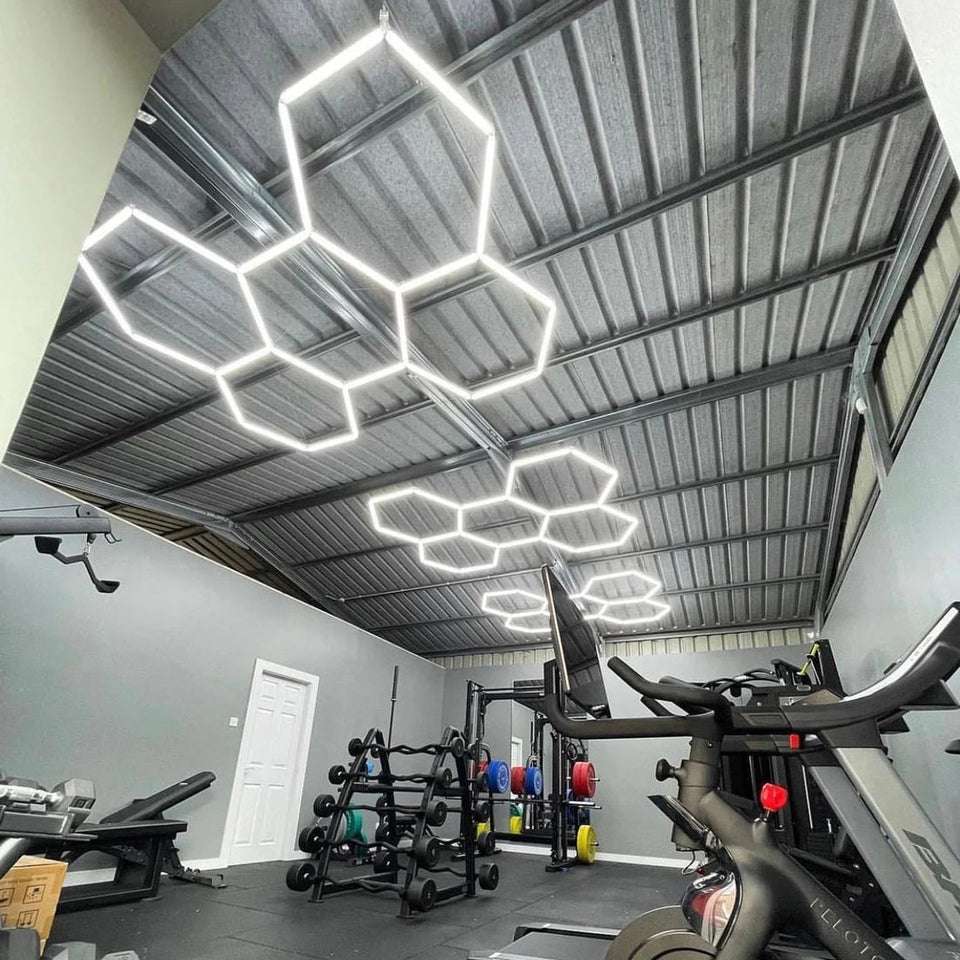
Professional-grade lighting for fitness content must solve two conflicting problems: providing enough intensity for high-frame-rate video (slow-motion lifting clips) while remaining soft enough to flatter the human form. Modular hexagon lighting systems have emerged as a leading solution for this specific application, bridging the gap between industrial performance and DIY aesthetic appeal.
Disclosure: This guide is based on technical specifications and internal testing of high-CRI LED systems. While we aim for objective data, individual results may vary based on specific room dimensions and electrical setups.
The Science of Skin Tones: Beyond Standard CRI
When evaluating lighting for video, most creators look at brightness (lumens), but the most critical metric for fitness content is the Color Rendering Index (CRI). CRI measures how accurately a light source reveals colors compared to natural sunlight. For human subjects, a CRI of 90 or higher is strongly recommended to ensure professional-grade color accuracy.
However, standard CRI (often referred to as $R_a$) is an average of only eight pastel colors. It frequently ignores the $R_9$ value, which represents saturated red. According to the IES LM-79-19 standard, detailed spectral data is required to truly understand a light's performance.
For fitness creators, $R_9$ is a vital metric. Because human skin tones rely heavily on red spectral components, a light with high $R_a$ but low $R_9$ can make a person look pale or slightly green on camera. High-performance hexagon systems prioritize a balanced spectrum, helping muscles look defined and skin look vibrant in 4K resolution.
How to Verify Quality: You can check a manufacturer’s LM-79 report. Look specifically for the "Color Rendering Index" table and find the $R_9$ value; a score above 50 is good, while 80+ is considered professional cinema quality.
Luminous Flux: Calculating Brightness for Camera Sensors
A common challenge in home gym setups is the "light hunger" of modern camera sensors. While the human eye adjusts easily to dim light, a camera sensor—especially when recording at 60 or 120 frames per second—requires significantly more photons to avoid digital noise (graininess).
A reliable heuristic for professional fitness spaces is to aim for 50–70 lumens per square foot at the subject's plane. In a 10'x10' (100 sq. ft.) recording area, this equates to a total output of 5,000 to 7,000 lumens.
Measurement Tip: You can test your setup using a digital Lux meter or a smartphone light meter app. Measure at chest height where you perform exercises. Aim for 500–750 Lux (approx. 46–70 foot-candles) for clean video at standard shutter speeds.
The modular hexagon design solves the "harshness" problem through surface area. By spreading the light across a wide grid, the system acts as a massive, ceiling-mounted softbox. This creates a diffuse light environment that fills in shadows under the chin and eyes, providing a "wrap-around" effect that highlights muscle definition.
The "Glass Box" Logic: Financial and Technical ROI
Upgrading to a high-CRI LED system is an investment in production quality that also offers measurable operational savings. We modeled a scenario for a 200-square-foot dedicated studio transitioning from legacy halogen or high-wattage fluorescent lighting to a modern LED hexagon array.
Comparative Performance Data
| Metric | Legacy Lighting (Halogen/Old FL) | High-CRI LED Hexagon System |
|---|---|---|
| Total Power Draw | 1,500W (3x 500W Floods) | 400W (Typical 5-Hex Grid) |
| Annual Energy Cost | ~$810 | $216 |
| CRI ($R_a$) | 70 - 80 | 90+ |
| Lumen Maintenance | Rapid decay (L70 < 8k hrs) | $L_{70}$ @ 30,000+ hrs |
| Estimated Payback | N/A | ~1.13 Years |
The Math Behind the ROI
To ensure transparency, we used the following assumptions for our "1.13-year payback" calculation:
- Usage: 3,000 production hours per year (approx. 8 hours/day).
- Electricity Rate: $0.18 per kWh (US Average commercial/residential blend).
- Initial Investment: $650 (Equipment cost) minus a $100 estimated utility rebate.
- Energy Savings Calculation: $(1.5kW - 0.4kW) \times 3,000h = 3,300 kWh$ saved per year.
- Financial Savings: $3,300 kWh \times $0.18 = $594$ annual savings.
- Payback Period: $$550 \text{ (Net Cost)} / $594 \text{ (Annual Savings)} = 0.92 \text{ to } 1.13 \text{ years}$ (depending on maintenance costs saved).
Note: For a personalized estimate, you can download our ROI Calculation Template (CSV) to input your local utility rates.
Environmental Impact: This upgrade avoids approximately 1.27 to 3.06 metric tons of $CO_2$ annually depending on your local power grid's carbon intensity (calculated at ~0.85 lbs $CO_2$/kWh saved).

Installation Strategy: Avoiding the "Ghostly" Look
Where you place your lights is as important as the specs. In fitness cinematography, the goal is to create "dimension"—showing the contours of the physique.
- The Eye-Line Rule: Mount the center of your hexagon array roughly 2–3 feet above and slightly in front of your primary workout position. This ensures light "fills" the eye sockets naturally.
- The 120° Advantage: Hexagon kits use 120° connectors, which offer a geometric balance between structural integrity and light overlap. This angle helps eliminate "dead zones" common in linear shop lights.
- Electrical Safety (NEC Compliance): According to the National Electrical Code (NEC), lighting circuits must be calculated based on continuous load. A typical 5-hexagon grid draws roughly 3.4 to 4 Amps. This is well within the 16-Amp limit (80% of a standard 20A circuit), usually allowing you to run lights and a camera on the same circuit.
Addressing Common Pitfalls: Glare and Flicker
Managing Specular Highlights: Because fitness equipment (dumbbells, racks) is often reflective, it can cause lens flare. The diffuse nature of hexagon tubes minimizes this, but if you see "hot spots," we suggest tilting your camera angle 5–10 degrees or slightly adjusting the subject's position.
Flicker-Free Performance: Low-quality LED drivers can cause "strobing" on camera, especially in slow motion.
- The Camera Test: Set your camera to a high shutter speed (e.g., 1/1000) or high frame rate (120fps). Look at the screen; if you see moving black bands or pulsing, the driver is not flicker-free.
- Safety Check: Ensure components are UL Listed, verifying they meet North American safety standards.

Summary of Benefits for Fitness Creators
The transition to high-CRI hexagon lighting is a move from "functional" to "professional." By controlling the spectral quality, you remove technical barriers between your expertise and your audience.
- Visual Authority: High CRI and $R_9$ values help ensure your physique and equipment look accurate on screen.
- Production Efficiency: Diffuse light can reduce time spent in post-production color grading.
- Operational Savings: A typical payback period of roughly one year makes this a self-funding business improvement.
Frequently Asked Questions
Can I install these lights myself? Most modern hexagon kits are designed for DIY installation with a standard 110V plug. However, if you plan to hardwire them into a ceiling junction box, we strongly recommend consulting a licensed electrician to ensure compliance with local building codes.
What color temperature is best for fitness videos? For most creators, 5000K (Daylight White) is ideal. It mimics natural sunlight, helping the camera maintain a neutral white balance. 6500K is available but can often appear too "blue" or clinical for a home gym.
How do I clean the lights? Dust on the tubes can reduce lumen output over time. Use a dry microfiber cloth to wipe the polycarbonate tubes every 3–6 months. Always ensure the lights are turned off and cool before cleaning.
YMYL Disclaimer: The information provided regarding lighting installation and electrical safety is for informational purposes only. Always consult with a qualified electrician for installations involving high-voltage wiring. Exercise caution when working on ladders or elevated surfaces.


