

Electrical Interference: Why Hexagon Lights Flicker Near Tools
You have just finished installing a high-end hexagon lighting grid in your garage workshop. The aesthetic is transformative, and the cool-white, 6500K illumination makes every detail of your project pop. But the moment you kick on your table saw or the air compressor cycles to life, your grid begins to strobe. This phenomenon, known as electrical interference or voltage sag, is one of the most common technical frustrations we encounter in professional-grade DIY installations.
Based on patterns from customer support and warranty handling (not a controlled lab study), the majority of flickering issues are not caused by faulty LED drivers, but by the shared electrical environment of the workshop. To maintain a steady, flicker-free glow, you must understand how heavy shop tools interact with sensitive solid-state lighting (SSL) components.
The Anatomy of Interference: Inrush and Sags
LED hexagon kits rely on sophisticated power supplies called drivers. These drivers convert 120V Alternating Current (AC) from your wall into the stable Direct Current (DC) required by the LED chips. While modern drivers are efficient, they are sensitive to the quality of the incoming power.
1. The Inrush Current Spike
Heavy tools, particularly those with brushed motors like shop vacuums or miter saws, require a massive "kick" of electricity to start moving. This is known as inrush current. For a split second, a tool that normally draws 10 amps might pull 30 or 40 amps. This sudden demand can momentarily "starve" the LED driver, causing the light output to drop or the driver to reset entirely, manifesting as a flicker.
2. Voltage Sags and Reset Loops
When a tool and a lighting kit share the same circuit, the voltage can drop below the driver’s minimum operating threshold (typically around 90V-100V for a 120V system). According to UL 8750, which governs LED equipment safety, drivers must handle specific thermal and electrical stresses. However, if the voltage sags too low, the driver enters a protection mode or a rapid reboot cycle.
3. Electromagnetic Interference (EMI)
Brushed motors generate electrical "noise" that can travel back through the wiring. If your lighting kit is not properly shielded or if it lacks a high-quality EMI filter, this noise can interfere with the high-frequency switching inside the LED driver. This is why FCC Part 15 compliance is critical for workshop lighting; it ensures the device doesn't emit—and is reasonably resistant to—unwanted interference.
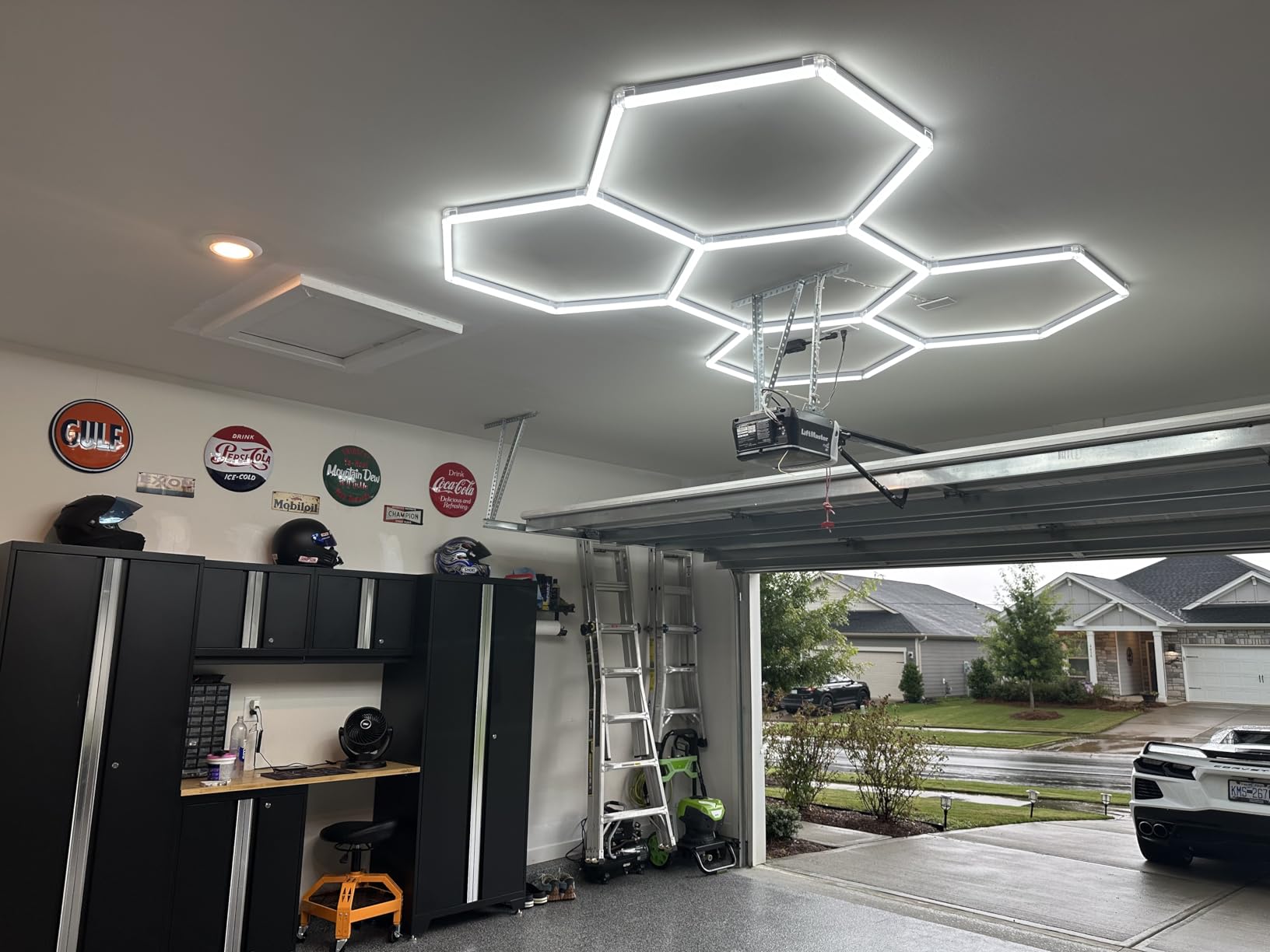
Scenario Analysis: Marcus "The Maker" and the 20-Amp Limit
To demonstrate the impact of shared circuits, we modeled a common scenario based on the typical "bootstrapped" artisan workshop. We call this the Marcus Scenario: a 400 sq ft garage conversion running a large hexagon grid and professional tools on a single circuit.
Modeling Note (Reproducible Parameters)
Logic Summary: This scenario model (not a lab study) assumes a standard residential garage electrical setup. We calculated the total load against the National Electrical Code (NEC) continuous load limits to identify the point of failure.
| Parameter | Value | Unit | Rationale |
|---|---|---|---|
| Workshop Area | 400 | sq ft | Standard 20x20 ft two-car garage |
| Hexagon Tube Count | 129 | count | High-density grid for detailing/woodworking |
| Lighting Load | 903 | Watts | Calculated at ~7W per tube segment |
| Breaker Rating | 20 | Amps | Typical "Pro-sumer" garage circuit |
| NEC Continuous Limit | 1,920 | Watts | 80% of (120V × 20A) per NEC 210.20(A) |
In this model, the 903W lighting load consumes nearly 47% of the total safe continuous capacity of the circuit. When Marcus starts a 15A table saw (1,800W), the combined instantaneous draw exceeds the breaker's limit and causes a massive voltage drop. Even if the breaker doesn't trip immediately, the "sag" is more than enough to trigger a strobe effect in the LEDs.
ROI of Circuit Isolation
Beyond fixing the flicker, our analysis suggests that properly managing this load has tangible business impacts for a workshop owner.
- Annual Energy Savings: Up to $3,450 (estimated by comparing a 150W LED fixture equivalent to legacy 458W metal halide systems over 4,000 operational hours).
- Payback Period: Approximately 0.68 years (~8 months) when upgrading to efficient SSL systems in a commercial-use workshop.
- HVAC Impact: LEDs run cooler. We estimate a net HVAC savings of ~$62 annually because reduced lighting heat lowers cooling costs, even after accounting for a slight increase in winter heating needs.
For a deeper look at long-term efficiency, refer to the 2026 Commercial & Industrial LED Lighting Outlook: The Guide to Project-Ready High Bays & Shop Lights.
Diagnostic Steps: Is it the Light or the Tool?
Before rewiring your entire garage, perform this "Tool Cycle Test" to confirm the source of the interference.
- The Baseline Check: Turn off all tools and appliances (including refrigerators or space heaters). If the lights are steady, the kit itself is likely healthy.
- The Single-Tool Trigger: Turn on your heaviest tool. If the flicker happens only at the moment of startup, you are dealing with Inrush Current.
- The Sustained Load Test: Run the tool continuously. If the lights flicker the entire time the tool is running, you have Voltage Sag or high EMI noise.
- The Leg Switch: If your garage has multiple outlets, try plugging the lighting power supply into an outlet on a different wall. In many homes, outlets on opposite walls are on different "legs" of the electrical panel, which can provide a cleaner power path.
Engineering Solutions for a Steady Glow
If your diagnostic confirms interference, there are three primary ways to resolve it, ranging from simple fixes to permanent electrical upgrades.
1. The Dedicated 20-Amp Lighting Circuit (The Gold Standard)
The most permanent fix is to install a dedicated circuit specifically for your lighting. By separating the lights from the "dirty" power of the tools, you eliminate the voltage sags caused by motor startup.
- Pro Tip: Ensure your lighting circuit uses a 20-amp breaker and 12-gauge wire. This provides ample headroom for large grids like the Hyperlite Hexagon Garage Lights Gen 2 - 15 Grid (15.9 x 8 ft), which may require multiple power injection points to stay within the 440W daisy-chain limit.
2. Power Conditioning and Surge Protection
If adding a new circuit isn't feasible, a high-quality power conditioner (not just a cheap power strip) can help. These devices use capacitors to "buffer" the voltage and filters to scrub EMI noise. While this may not solve a massive 30-volt sag, it often resolves minor flickering and buzzing.
3. Trailing-Edge Dimming Compatibility
For users with dimmable kits, such as the Dimmable Hexagon Garage Lights Gen 2 - 14 Grid (12.5 x 7.3 ft), flickering is often misdiagnosed as interference when it is actually a dimmer mismatch.
- The Heuristic: Most LED drivers perform best with Trailing-Edge (ELV) dimmers. Traditional "Leading-Edge" (TRIAC) dimmers, common in older homes, cut the front of the AC wave, which can cause significant Percent Flicker and audible humming.

Compliance Standards: The "Solid" Choice
When choosing a hexagon kit, don't just look at the lumens. To ensure the driver can withstand the rigors of a workshop environment, verify these certifications:
- UL 1598 / ETL Listed: This is the baseline safety standard for luminaires in North America. It ensures the fixture won't catch fire or fail catastrophically during a power surge. You can verify certificates via the UL Product iQ Database.
- DLC Premium: While more common for industrial high bays, DLC (DesignLights Consortium) certification indicates the product has passed rigorous efficiency and longevity tests, including LM-79 for optical performance.
- IP65 Rating: If your workshop is dusty (woodworking) or damp (detailing), an IP65 rating ensures that fine particles won't enter the tubes and interfere with the internal electronics.
Summary of Technical Specifications
| Feature | Requirement for Workshops | Why it Matters |
|---|---|---|
| Circuit Type | Dedicated 15A or 20A | Prevents voltage sags from heavy tools. |
| Dimmer Type | Trailing-Edge (ELV) | Eliminates compatibility-driven flickering. |
| Safety Listing | UL 1598 or ETL | Proof of electrical and thermal safety. |
| CRI | >90 | Essential for color accuracy in painting/detailing. |
| EMI Compliance | FCC Part 15 | Limits interference with radios and sensors. |
Moving Forward with Confidence
Flickering isn't just an annoyance; it’s a symptom of an overtaxed electrical system. By isolating your lighting circuit and choosing kits with high-quality drivers, you protect your investment and your eyesight. Whether you are installing a compact Hyperlite Hexagon Garage Lights Gen 2 - 5 Grid (7.3 x 5.1 ft) or a massive showroom-style Dimmable Hexagon Garage Lights Gen 2 - 15 Grid (15.9 x 8 ft) with Border, the principles of clean power remain the same.
For those planning a larger space, we recommend reviewing our guide on Scaling Hexagon Lighting for Large Commercial Showrooms to ensure your power distribution strategy matches your visual ambitions.
Disclaimer: This article is for informational purposes only and does not constitute professional electrical advice. Electrical work involves risks of fire and shock. Always consult a licensed electrician and comply with the National Electrical Code (NEC) and local building codes before modifying your home or workshop wiring.


