

In the high-stakes environment of a premium barbershop, the difference between a standard haircut and a masterpiece often comes down to what the barber can actually see. Precision fading, intricate beard shaping, and subtle hair coloring require a visual environment that eliminates guesswork. While traditional linear fluorescent or standard LED panels have long been the industry norm, a shift toward 5000K (Kelvin) hexagon lighting grids has redefined the "Value-Pro" standard for modern grooming establishments.
This transition is not merely an aesthetic trend driven by social media; it is rooted in optical physics, ergonomic necessity, and commercial efficiency. By understanding the technical synergy between Correlated Color Temperature (CCT), Color Rendering Index (CRI), and geometric light distribution, shop owners can transform their workspace into a high-performance studio.
The Physics of Precision: Why 5000K and High CRI Matter
For barbers and stylists, the color of light is as critical as its intensity. The choice of 5000K—often referred to as "Cool White" or "Natural Daylight"—is intentional. According to the ANSI C78.377-2017 standard, which defines the chromaticity specifications for solid-state lighting, 5000K falls within a specific range that mimics the clarity of noon-day sun.
In a barbershop context, 5000K lighting provides several functional advantages:
- Enhanced Contrast: Higher color temperatures increase the visual contrast between different hair textures and skin tones, making it easier to identify "weight lines" in a fade.
- Neutrality: Unlike 2700K (warm white), which can cast a yellow hue that distorts hair color, or 6500K, which can appear overly blue and sterile, 5000K provides a neutral baseline.
- Reduced Eye Strain: For practitioners working 8- to 10-hour shifts, a crisp, balanced spectrum reduces the cognitive load required to focus on minute details.
However, CCT is only half of the equation. The Color Rendering Index (CRI) determines how accurately a light source reveals colors compared to natural light. For professional hair coloring and skin-close shaves, a CRI of 90 or higher is the benchmark. As noted in research regarding high-performance white lighting, achieving concurrent high CRI and high luminous efficiency is a technical challenge, but it is essential for detecting the subtle tonal differences in hair dye or the fine details of a client's skin.
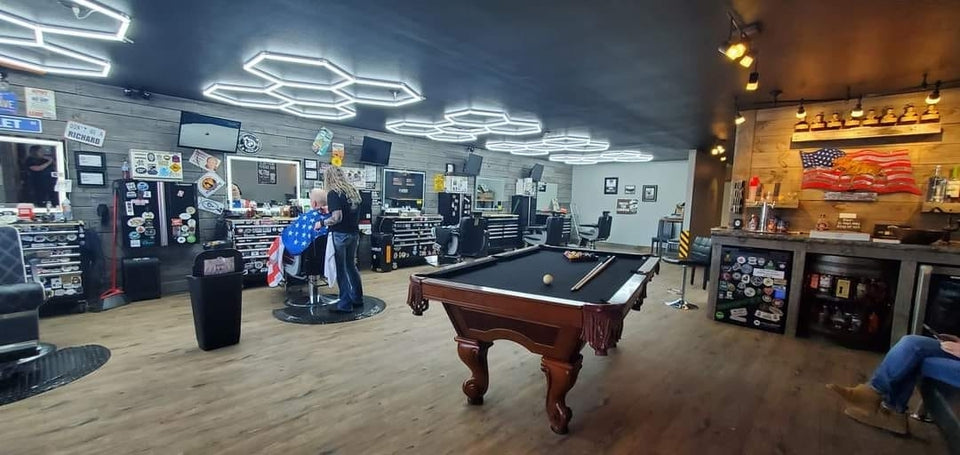
Eliminating the "Brow Shadow": The Geometric Advantage
The most common lighting failure in a barbershop is the "Brow Shadow"—harsh shadows cast under the brow, nose, and chin when light originates from a single point source or a poorly placed linear fixture. This forces the barber to constantly adjust the client's head or their own position to see clearly.
Hexagonal lighting grids solve this through multi-directional distribution. A hexagonal structure provides light from six different angles simultaneously. When these fixtures utilize a 120-degree beam angle, the light "wraps" around the subject. This effectively washes the vertical plane—the client's face and head—with uniform, shadow-free illumination.
The "Center-of-Head" Rule: Experienced shop fitters recommend a layout where the center of the primary hexagon grid aligns directly with the client's seated head position as seen in the mirror. This ensures that the primary task area is at the intersection of multiple light paths, neutralizing shadows that would otherwise be created by the barber’s own hands or tools.
Commercial ROI and Energy Compliance
Investing in high-end lighting is a capital expenditure that must be justified by operational savings and long-term reliability. For a typical 6-chair urban barbershop operating 4,000 hours annually, the transition from legacy 400W metal halide or high-wattage fluorescent systems to modern LED hexagon grids offers a staggering Return on Investment (ROI).
Based on a simulated commercial environment, the financial and environmental impacts are detailed below:
| Metric | Value (Estimated) |
|---|---|
| Annual Energy & Maintenance Savings | $3,446 |
| Simple Payback Period | 0.35 Years (approx. 4 months) |
| Annual Carbon Reduction | 1.93 Metric Tons of CO2 |
| 5-Year Cumulative Carbon Savings | 9.64 Metric Tons |
| Equivalent Gasoline Saved | 217 Gallons per year |
Values estimated based on $0.18/kWh electricity rate and typical urban labor costs for maintenance.
Beyond direct savings, owners should prioritize fixtures listed on the DesignLights Consortium (DLC) Qualified Products List (QPL). DLC certification is often a prerequisite for utility rebates, which can significantly offset the initial purchase price. In many jurisdictions, upgrading to DLC-certified LED systems can net the business owner between $45 and $80 per fixture in direct rebates.
Safety Standards and Electrical Integrity
In a commercial setting, "Value-Pro" means more than just brightness; it means safety and code compliance. Barbershops are subject to rigorous electrical inspections and must adhere to the National Electrical Code (NEC).
1. UL and ETL Certification
Every fixture installed in a professional establishment should bear a mark from a Nationally Recognized Testing Laboratory (NRTL). As explained in the UL Solutions Product iQ Database, UL 1598 is the core safety standard for fixed luminaires. It ensures the product has been tested for fire safety, electrical shock resistance, and structural integrity. Using non-certified "consumer-grade" lights can void insurance policies and lead to failed building inspections.
2. The 440W Daisy-Chain Limit
A common technical "gotcha" during installation is exceeding the manufacturer's maximum wattage for a single power feed. Most commercial-grade hexagon tubes are designed to be daisy-chained, but they have a hard limit—typically around 440W or 62 individual tubes per power cable.
For a large 11-grid or 12-grid setup, which may include over 160 tubes, a single power injection point is insufficient. In our technical simulation of a 161-tube grid:
- Total Draw: Approximately 1,127W.
- Amperage: 9.4A on a 120V circuit.
- Requirement: At least three separate power injection points are necessary to stay within safety margins and prevent overheating of the internal wiring connectors.

Regulatory Compliance: Title 24 and ASHRAE 90.1
For shop owners in regions like California, lighting must meet the California Title 24, Part 6 Building Energy Standards. These regulations mandate specific Lighting Power Densities (LPD) and often require automatic controls, such as occupancy sensors or multi-level dimming.
Similarly, ASHRAE Standard 90.1-2022 sets the benchmark for commercial energy efficiency across North America. High-efficiency hexagon systems that deliver over 110 lumens per watt (lm/W) not only meet these codes but often exceed them, allowing for a higher "lighting budget" in other areas of the shop, such as decorative neon accent lighting or retail display spotlights.
Maintenance and Long-Term Reliability
The longevity of a lighting system is determined by its thermal management and component quality. Professional buyers should look for IES LM-80-21 reports, which document the lumen maintenance of the LED chips over time. A fixture claiming "50,000 hours" should be backed by IES TM-21-21 projections, which use mathematical models to predict when the light output will drop below 70% of its original brightness ($L_{70}$).
Pro-Tip for Maintenance: In a barbershop, hair clippings and product aerosols (like hairspray) can accumulate on the surface of the LED tubes, reducing light output and increasing heat. High-quality fixtures made of Polycarbonate (PC) construction are easier to clean and resist yellowing compared to cheaper plastics. A quarterly wipe-down with a microfiber cloth ensures the system maintains its 5000K clarity for years.
Strategic Layout for Maximum Impact
To achieve a professional-grade installation, follow this three-tiered approach:
- Primary Task Layer: Install hexagon grids directly over the workstations. Ensure the grid extends at least 12 inches beyond the chair in all directions to provide side-lighting for the ears and neckline.
- Ambient Fill Layer: Use perimeter lighting—such as wall-mounted hexagons or linear strips—to balance the room’s brightness. This reduces the "cave effect" and makes the space feel larger and more inviting for waiting clients.
- Accent Layer: Integrate brand-specific elements, like neon strips or dimmable grids, to create a unique visual identity that translates well to photography and social media marketing.
Summary of Technical Specifications for Barbershops
| Feature | Professional Recommendation | Why It Matters |
|---|---|---|
| CCT | 5000K | Mimics natural daylight for color accuracy. |
| CRI | >90 | Essential for hair coloring and skin details. |
| Beam Angle | 120° | Ensures light wraps around the head to kill shadows. |
| Efficiency | >110 lm/W | Reduces operational costs and meets energy codes. |
| Certification | UL/ETL & DLC | Guarantees safety and eligibility for rebates. |
| Material | Polycarbonate (PC) | Lightweight, durable, and easy to maintain. |
By prioritizing these technical benchmarks, barbershop owners can move beyond simple illumination and invest in a precision tool that enhances their craft, protects their bottom line, and provides a superior experience for every client who sits in their chair.
YMYL Disclaimer: This article is for informational purposes only and does not constitute professional electrical, legal, or financial advice. All electrical installations must be performed by a licensed electrician in accordance with local building codes and the National Electrical Code (NEC). Consult with a qualified tax professional regarding the eligibility of energy efficiency rebates and tax credits.
Sources
- ANSI C78.377-2017: Specifications for the Chromaticity of Solid State Lighting Products
- IES LM-79-19: Optical and Electrical Measurements of Solid-State Lighting Products
- DesignLights Consortium (DLC) Qualified Products List
- UL Solutions Product iQ Database
- California Energy Commission: 2022 Building Energy Efficiency Standards


