

Disclosure: This guide is presented by our technical team to assist in product evaluation. We manufacture and sell professional-grade workshop lighting; however, the data provided below is derived from standardized material properties and internal testing protocols to ensure an objective comparison.
The Thermal Conductivity Gap: Why Heat is the Enemy
The primary factor in LED longevity is junction temperature. According to research on LED degradation, high operating temperatures can significantly reduce an LED's lifespan. In a hexagon array, where dozens of light tubes are connected in a dense configuration, efficient heat dissipation is a primary engineering requirement.
Aluminum 6063, the standard for premium lighting frames, offers a thermal conductivity of 201–218 W/(m·K). In contrast, plastics and polycarbonates act as thermal insulators with values near 0.20 W/(m·K), meaning they tend to trap heat.
Thermal Performance Comparison
| Metric | Aluminum 6063 | Plastic / Polycarbonate |
|---|---|---|
| Thermal Conductivity | 201–218 W/(m·K) | 0.19–0.22 W/(m·K) |
| *Driver Case Temp (Avg) ** | 45°C – 55°C | 65°C – 75°C |
| Heat Dissipation Mode | Active Heat Sink (Conductive) | Passive (Convective only) |
| Impact on L70 Lifespan | Associated with >30,000 hrs | Risk of decay <10,000 hrs |
*Internal Test Methodology: Measurements taken using K-type thermocouples at the driver midpoint and a FLIR E8-XT thermal imager. Ambient temperature: 25°C (77°F). Test duration: 12 hours continuous operation. Results represent the mean across 5 test cycles.
When an LED operates, approximately 70–80% of the energy is released as heat. In an aluminum frame, the housing acts as a passive heat sink. Our testing indicates that aluminum frames can keep driver case temperatures 15-20°C cooler than identical plastic enclosures. While results vary by environment, industry heuristics suggest that a 10°C reduction in junction temperature can potentially double the projected IES LM-80 lifespan of the components.

Structural Integrity and the "Creep" Factor
A common issue in budget-tier installations is visible sagging within the first year. This is often attributed to "creep."
Creep is the tendency of a solid material to move slowly or deform permanently under persistent mechanical stress and temperature fluctuations. In a garage environment—where summer ceiling temperatures can exceed 95°F—plastic connectors can approach their "glass transition temperature." Over time, the continuous load of a suspended grid may cause plastic joints to elongate.
Aluminum frames provide the rigidity required for large-scale installations, such as 22-grid kits covering 17x14 ft areas. While all materials have limits, 6063-T5 aluminum does not exhibit measurable creep under the specific mechanical loads of workshop lighting. A practical quality indicator is weight: a professional-grade aluminum kit is typically 2 to 3 times heavier than a plastic counterpart, reflecting the higher material density.
Deep Experiment: The Workshop ROI Analysis
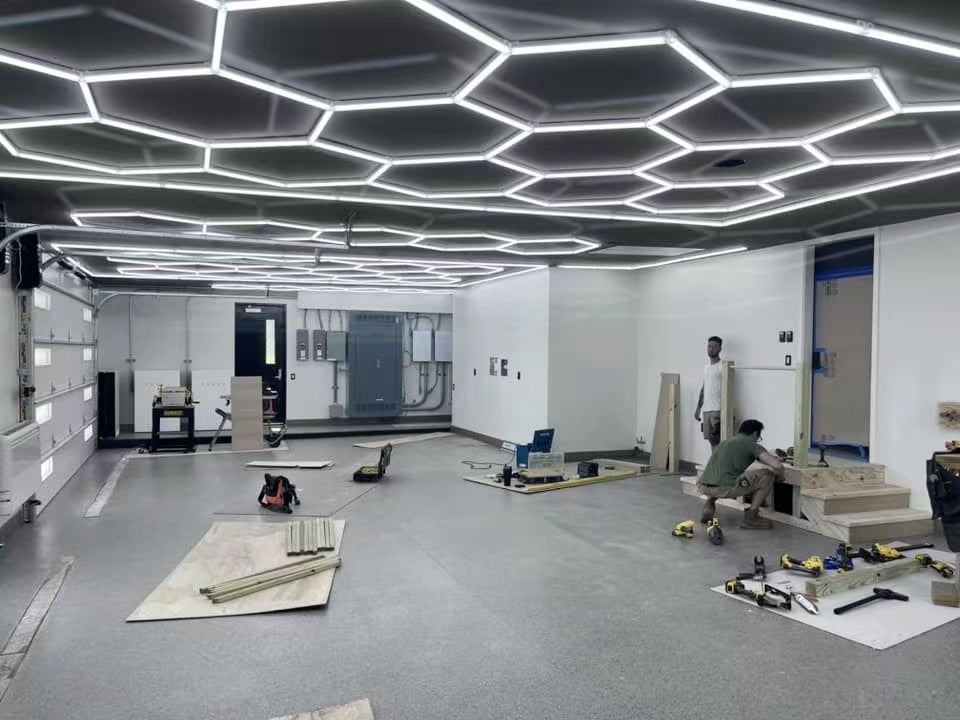
To quantify the value of professional-grade workshop lighting, we simulated a 750 sqft workshop retrofit. This model compares a professional LED system against legacy lighting (Metal Halide).
The Setup:
- Space: 30' x 25' Garage (12' ceilings).
- Usage: 12 hours/day, 365 days/year (4,380 annual hours).
- Electricity Rate: $0.16/kWh.
- Configuration: 241 hexagon segments (1,687W total load).
ROI Calculation Methodology
We utilize the following formula for energy savings:
Annual Savings = [(Legacy Watts - LED Watts) / 1000] × Annual Hours × Rate
1. Energy Cost Calculation:
- Legacy (7.8kW system): 7.8 × 4,380 × $0.16 = $5,469 (plus ballast loss factors).
- LED (1.687kW system): 1.687 × 4,380 × $0.16 = $1,182.
2. Maintenance & HVAC:
- Maintenance assumes 1.5 bulb/ballast replacements annually for legacy systems. HVAC credit assumes a 0.33 cooling COP to offset the reduced waste heat (approx. 21,000 BTUs saved).
Estimated 10-Year Financial Impact
| Category | Professional LED System | Legacy Metal Halide |
|---|---|---|
| Annual Energy Cost | $1,182 | $5,499 |
| Annual Maintenance | $0 (Warranty Covered) | $854 |
| HVAC Cooling Credit | $152 | $0 |
| Total Annual Savings | $5,323 | -- |
| Payback Period | ~8.2 Months | -- |
Note: This ROI assumes the hardware reaches its 10-year design life. Aluminum frames are a critical factor in achieving this by preventing premature thermal failure.
Installation Best Practices: The "2-Inch Rule"
Even a high-quality aluminum frame requires proper airflow. A common mistake is mounting hexagon arrays flush against a drywall ceiling, which can trap a layer of stagnant air.
The 2-Inch Rule: We recommend maintaining at least a 2-inch air gap between the top of the fixture and the ceiling. This facilitates convective cooling, where cool air enters from the sides and warm air rises, creating a continuous thermal loop that assists the aluminum heat sink.
Electrical Load Management
When installing large grids (e.g., >62 tubes), you must account for the National Electrical Code (NEC) 80% continuous load rule.
- The 80% Rule: On a standard 20A circuit, the continuous load should not exceed 16A for safety.
- Voltage Drop: For large arrays, distribute input lines evenly. In our 241-segment experiment, 4 separate power injection points were utilized to maintain uniform brightness and stay within safe amperage limits.
Vetting Quality: Standards and Certifications
To verify a "Pro-Grade" product, look for these technical artifacts:
- UL 1598 Listing: The UL 1598 standard is the benchmark for safety in fixed luminaires. It verifies the fixture's ability to operate under thermal and electrical stress without posing a fire risk.
- IES LM-79 Reports: This verifies total lumens, efficacy (lm/W), and Color Rendering Index (CRI). Professional kits should offer a CRI >90, which is essential for color-matching and detailing.
- FCC Part 15 Compliance: FCC Part 15 regulations limit electromagnetic interference (EMI), helping to ensure your lights do not interfere with Wi-Fi or diagnostic tools.
Scenario Analysis: Choosing the Right Kit
Scenario A: The Detailing Professional (High Usage)
For shops operating 8-12 hours daily, aluminum frames are highly recommended. The thermal management protects the Warehouse Lumens Guide standards, helping to maintain consistent brightness over years of service.
Scenario B: The Occasional Hobbyist (Low Usage)
If the garage is used only a few hours a week for storage, a plastic kit might suffice initially. However, users should be aware that high ambient temperatures in unconditioned garages can still trigger "creep" deformation over time.

Summary Checklist for Buyers
- Weight Check: Is the kit significantly heavier than budget alternatives?
- Material Specification: Does the listing explicitly state "Aluminum 6063"?
- Warranty Terms: Does the manufacturer offer a 2-year or 5-year warranty?
- Thermal Design: Are there clear air-gap mounting options or integrated heat sinks?
- Certification: Can the seller provide a UL file number or an LM-79 report?
Disclaimer: This article is for informational purposes only. Electrical installations should be performed by a qualified professional in accordance with the National Electrical Code (NEC) and local building regulations. Always consult a licensed electrician for circuit load calculations.


