

Why Start Small? The Magic of Modular Lighting
Picture this: You’ve just cleared out the clutter in your two-car garage. The floor is freshly epoxied, your tools are finally organized, and you’re ready to transform this space into the ultimate workshop. You want that high-end, honeycomb glow you’ve seen all over social media, but looking at the price of a full-ceiling kit makes you hesitate. Or maybe you're worried that once you install it, you'll realize you wanted the grid three feet to the left.
We’ve been there. In our experience helping hundreds of DIYers, the biggest barrier to a dream setup isn't the installation—it's the "all-or-nothing" mindset.
The beauty of a modular hexagon system is that it’s designed to grow with you. You can start with a single "seed" kit over your workbench today and expand it into a full-ceiling masterpiece next year. This guide will show you how to plan for that expansion from day one, ensuring your lighting remains safe, symmetrical, and spectacular as it grows.

The "Seed" Strategy: Planning for Growth
The most common mistake we see is centering the first kit on the ceiling without a long-term plan. While a centered 5-grid kit looks great on day one, it creates a massive headache on day 365 when you want to add more. You’ll find yourself either forced into an awkward, off-center final design or having to tear down and reinstall the entire system to maintain symmetry.
Start at the Boundaries
Instead of centering, we recommend an "edge-first" approach. Think of your first kit as a "seed." Place it in a corner or along a primary wall (like above your main workbench). This allows the grid to "grow" organically across the ceiling. By starting at a future boundary, you minimize the number of temporary "edge hexes"—those tubes that only have three or four connections—which can be structural weak points during the expansion phase.
Geometry and Grid Density
A standard cluster of three hexagon lights (using ~955mm wide grids) covers approximately 2.6 square meters. This is a perfect "unit" for planning. If you know your garage is 20 feet wide, you can calculate exactly how many "units" will eventually fit across that span. Aligning your first kit with these future grid lines is the secret to a professional-looking finish.
Logic Summary: Our "Edge-First" heuristic is based on observed systemic inefficiencies in heterogeneous expanding networks. Starting at the boundary reduces routing bottlenecks and structural stress on connectors during the "incomplete" phases of the build-out.
Electrical Constraints: The 62-Tube Rule
Before you snap your first two tubes together, we need to talk about the "hard limits" of electricity. Modular doesn't mean "infinite."
The 440W Ceiling
Most high-quality modular hex systems have a specific electrical ceiling. For a standard Gen 2 tube system, the limit is 62 tubes or 440W per power cable.
Why does this matter?
- Voltage Drop: If you exceed 62 tubes on a single power feed, the electricity has to travel too far through thin internal wiring. This causes "voltage drop," where the tubes farthest from the power source look noticeably dimmer or flicker.
- Driver Stress: Pushing past 440W can trip the internal driver or, worse, cause heat buildup that shortens the life of your LEDs.
Planning Multiple Power Feeds
If your dream is a 200-tube grid, you need to plan for separate, balanced power zones from the start. For a large grid, the "rule of thumb" is to split the layout into electrically independent zones (North, South, East, West) that meet in the middle visually but stay separate electrically.
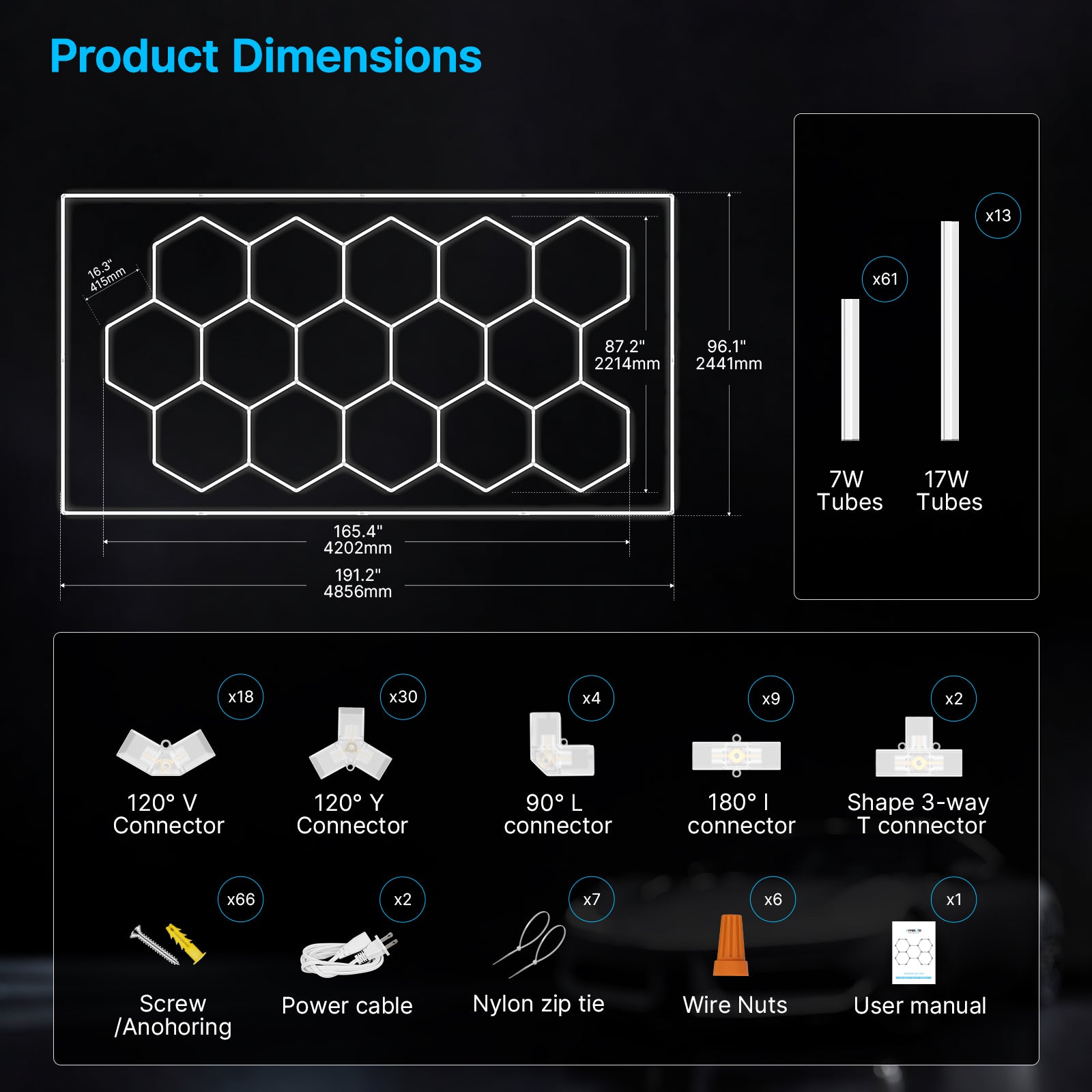
Modeling the Dream: A 2-Car Garage Expansion Case Study
To show you what’s possible, we modeled a scenario for a Serious DIY Hobbyist with a typical 28x22 ft (616 sq ft) garage. This user started with one small kit and expanded to a full-ceiling grid over 18 months.
Scenario: The 198-Tube Workshop Grid
Under this model, the user achieves professional-grade task lighting (~85 lumens/sq ft), which far exceeds the IES RP-7 standard for industrial facilities, ensuring every detail of a woodworking or automotive project is visible.
| Parameter | Value | Rationale / Source |
|---|---|---|
| Total Tubes | 198 | Calculated for 616 sq ft using a 1.75 geometry factor |
| Total Wattage | 1,386W | 198 tubes × 7W per tube (Gen 2 specs) |
| Power Feeds | 4 Separate Lines | Based on the 440W max-per-cable limit |
| Circuit Load | 11.6 Amps | Safe for a standard 20A garage circuit (120V) |
| Annual Savings | ~$1,406 | Estimated vs. legacy 8-fixture fluorescent setup |
Methodology Note: This is a deterministic scenario model, not a laboratory study. We assumed a usage pattern of 1,200 hours per year and an average US electricity rate of $0.14/kWh. ROI includes avoided maintenance and HVAC cooling credits (LEDs run cooler than old shop lights).
The Environmental "Win"
Beyond the looks, this expansion has a real impact. Our modeling shows that switching a large garage to an efficient hex grid can reduce carbon emissions by approximately 3.8 metric tons of CO2 annually. That’s the equivalent of planting 63 tree seedlings and letting them grow for 10 years! For a deeper dive into how modern lighting impacts your project's footprint, check out the 2026 Commercial & Industrial LED Lighting Outlook.
Step-by-Step: Adding Your First Expansion Kit
Once you have your "seed" kit installed and you’re ready for more, follow these steps to ensure a seamless connection.
- Map the Connectors: Before climbing the ladder, lay your new tubes out on the floor. Identify which "V" or "Y" connectors from your existing grid will act as the bridge to the new section.
- Check the Load: Verify that your current power cable isn't already nearing the 62-tube limit. If it is, you'll need to run a second power injection point for the new section.
- The "Straight-In" Technique: This is the most important tip from our support bench. While the connectors are robust, inserting a tube at a slight angle can stress the plastic. Align the tube perfectly straight, apply firm, even pressure, and listen for a distinct "click." If you don't hear the click, the waterproof seal and electrical connection may not be seated properly.
- Balance the Grid: If you are adding a large section, try to grow the grid symmetrically from your seed to keep the weight distribution even if you are using a suspended mounting system.

Expertise & Compliance: Making it "Solid"
When you move from a few decorative hexes to a full-ceiling system, you’re moving into the realm of professional electrical work. To keep your home insurance happy and your garage safe, keep these standards in mind:
- UL 1598 Compliance: Ensure your kits are UL 1598 listed. This is the gold standard for fixed luminaires in North America. Using uncertified "no-name" kits from discount sites can be a fire hazard.
- NEC (National Electrical Code): Per NFPA 70, any continuous load (lighting that stays on for 3+ hours) should not exceed 80% of the circuit's capacity. Our 198-tube model uses ~11.6A, which is well within the 16A limit (80% of a 20A breaker).
- 0-10V Dimming: For large grids, we highly recommend using 0-10V dimming. Unlike standard household dimmers, 0-10V systems use a separate low-voltage signal to tell the driver how much light to put out. This prevents the "humming" and "flickering" often seen when trying to dim large LED arrays.
Troubleshooting Common Expansion Growing Pains
Even with the best planning, you might run into a few "gotchas." Here’s how to handle them:
- The "Dim End" Syndrome: If the last few hexes in your expansion look dimmer than the rest, you’ve likely hit a voltage drop issue. Solution: Run an additional power feed to the far end of the grid.
- The "Wandering" Grid: Over a 20-foot span, even a 1/8-inch misalignment in your first kit can result in a 2-inch gap at the other end. Solution: Use a laser level or chalk line to mark your grid path on the ceiling before you start snapping tubes together.
- Flickering: Usually caused by a loose connection. Go back and perform the "click test" on every joint in that section.

What to Expect: Frequently Asked Questions
Can I mix different brands of hexagon lights? In most cases, no. Even if they look identical, the pin configurations and tube lengths (often varying between 17.4" and 17.5") are usually proprietary. Mixing brands can lead to poor connections or electrical failure.
How do I handle expansion in a circular or irregular room? Surprisingly, hex grids are better for this than square grids! Because hex connections are non-orthogonal (they don't just go 90 degrees), they can "snake" around corners or accommodate irregular walls more easily than traditional shop lights.
Do I need an electrician to expand my grid? If you are simply snapping in more tubes to an existing power feed (under the 62-tube limit), it’s a standard DIY project. However, if you need to run new 120V circuits or install 0-10V dimming controllers, we recommend consulting a licensed professional to ensure everything meets local codes.
Will the color match if I buy kits a year apart? High-quality manufacturers adhere to ANSI C78.377 standards for chromaticity. This ensures that a "6500K" tube bought today will look the same as one bought next year. Cheap, uncertified kits often have "color shift," where new tubes might look more blue or yellow than the old ones.
Final Thoughts
Building a modular hex grid is like playing with professional-grade LEGOs. It’s rewarding, aesthetic, and incredibly functional. By starting with a "seed" strategy and respecting the electrical limits, you can build a lighting system that is as solid and reliable as the work you do beneath it.
For more inspiration on combining different lighting styles, check out our guide on Hybrid Garage Lighting: Combining UFOs and Hex Grids.
YMYL Disclaimer: This article is for informational purposes only. Electrical work involves inherent risks of fire and shock. Always consult with a licensed electrician for new circuit installations and ensure all products used are UL/ETL certified for your specific application.


