

Task vs. Ambient: Choosing Between Hexagons and Neon Signs
Picture this: You step into your garage after a long day. You’ve got a project waiting—maybe a classic car that needs paint correction or a workbench that’s currently a graveyard of half-finished electronics. You flip the switch. Does your space transform into a high-definition workshop where every detail pops, or does it feel like a dim cave where you’re squinting to find a 10mm socket?
Choosing the right lighting isn't just about "brightness." It’s about the difference between task lighting (the muscle that helps you work) and ambient lighting (the soul that gives your space personality). Today, we’re pitting two of the hottest trends in garage and shop décor against each other: modular LED hexagon grids and custom LED neon signs.
Whether you’re a pro detailer or a "man cave" enthusiast, we’ve got the technical breakdown to help you decide which one deserves a spot on your ceiling—or your wall.
The Powerhouse: Hexagon Lighting for Task Performance
If your garage is a place where "real work" happens, you need more than just a glow. You need high-lumen density and uniform coverage. This is where hexagon grids shine—literally.
Why Hexagons Rule the Workbench
Hexagon lights are designed to solve the "shadow problem." In a typical garage with one or two central bulbs, your own body often blocks the light when you lean over a car or a saw. According to the IES RP-7-21 Recommended Practice for Industrial Facilities, achieving uniform illuminance is critical for safety and precision.
Hexagons use a multi-angled approach. Because the tubes form a honeycomb pattern, the light beams overlap from multiple directions. This creates a "shadowless" environment. We often see DIYers switch to hexagons because they provide a 180-degree beam angle (based on standard tube housing designs), which eliminates those frustrating dark spots under the hood or along the side panels of a vehicle.
The Technical Specs That Matter
When you’re shopping for task lighting, don't just look at the wattage. Look at these three metrics:
- Luminous Efficacy: High-quality hex kits typically deliver around 110 lumens per watt (lm/W). For a standard 24x18 ft garage, we’ve modeled that you’d need roughly 77,000 total lumens to hit the "pro-detailing" sweet spot of 80–90 foot-candles at the work plane.
- CRI (Color Rendering Index): For paint correction or electrical work, you need a CRI of 90 or higher. This ensures that colors look "true" and you can spot subtle swirls in clear coats or distinguish between colored wires.
- CCT (Color Temperature): Most task-focused hex lights are 6500K. This is a "cool daylight" that keeps you alert and mimics high-noon sun, which is ideal for focus.

The Ambiance: Custom LED Neon for the "Vibe"
Now, let’s talk about the other side of the coin. Sometimes, you don't want your garage to feel like an operating room. You want it to feel like a destination—a place to grab a drink, show off your collection, or just hang out.
The Decorative Edge
Custom LED neon signs are purely decorative. While a hexagon grid is functional, a neon sign is emotional. It tells a story. Whether it’s your shop’s logo or a classic "Garage" script, neon provides a directional glow that draws the eye.
However, from a photometric standpoint, neon is a "low-intensity" source. While a hexagon grid can easily deliver 200–500 lux for mechanical work, a neon sign typically provides under 50 lux. It’s meant to be looked at, not worked under.
Pro Tip: The "Dark Wall" Strategy
Based on our observations of hundreds of custom installs, neon signs have the most visual impact when mounted on dark, matte walls (think charcoal grey or matte black). A light-colored wall can "wash out" the glow by reflecting too much ambient light, whereas a dark wall makes the colors pop. If you're looking for more inspiration on how to integrate these into a professional setting, check out the 2026 Commercial & Industrial LED Lighting Outlook.
Decision Framework: Task vs. Ambient
To help you choose, we’ve broken down the two options based on our scenario modeling for different garage users.
| Feature | Hexagon Lighting Grid | Custom LED Neon Sign |
|---|---|---|
| Primary Goal | High-precision task work | Branding & Ambiance |
| Lumen Output | High (~110 lm/W) | Low (Decorative only) |
| Installation | Modular ceiling/wall mount | Wall-mounted accent |
| Ideal For | Detailing, Mechanics, Gyms | Man Caves, Lounges, Logos |
| Color Quality | High CRI (>90) for accuracy | Vibrant colors for "pop" |
| Energy Impact | High efficiency (DLC-ready) | Low draw (40W–60W avg) |
Methodology Note: How We Modeled This
Our analysis of these two systems is based on a deterministic scenario model for a standard 2-car residential garage (24x18 ft). We used the Zonal Cavity Method to estimate required light levels.
Modeling Parameters:
- Room Dimensions: 24ft x 18ft x 10ft (Ceiling Height)
- Work Plane: 2.5ft (Workbench height)
- Target Illuminance: 87.5 foot-candles (Task) vs. <5 foot-candles (Ambient)
- Reflectance: 50% Wall / 80% Ceiling / 20% Floor
- Utility Rate: $0.16/kWh (US Average)
Logic Summary: We assumed a "Detailing Enthusiast" persona who uses the space 1,200 hours per year. Under these parameters, the hexagon system provides a 2-year ROI compared to legacy fluorescent lighting due to energy savings and reduced maintenance.

Installation Gotchas: What We’ve Learned
Installing these lights is a great weekend DIY project, but there are a few "expert secrets" that can save you a headache.
For Hexagon Grids: The Power Injection Rule
A common mistake we see is trying to run too many tubes off a single power cord. Most high-quality kits have a 440W limit per power injection point. If you have a large 14-grid layout, you may need 2 or 3 separate power lines distributed evenly to prevent voltage drop or overheating the connectors.
- Firm Push: The modular connectors require a firm, straight push to seat correctly. If one segment isn't lighting up, 90% of the time it’s a slightly misaligned pin.
For Neon Signs: Laser Precision
Because neon signs often come with a rigid acrylic backing, your drill points need to be perfect. We recommend using a laser level to mark your points. Handling the sign is a two-person job—the acrylic is durable, but the LED tubes can be sensitive to twisting during the mounting process.
E-E-A-T: Safety and Standards
When you’re installing electrical equipment in a garage, safety isn't optional. You should always look for products that meet North American safety standards.
- UL and ETL Certification: Ensure your power drivers are UL Listed or ETL Listed. This proves the product has been tested for fire and shock safety under the UL 1598 standard.
- DLC Qualification: If you are a small business owner, check if the lights are on the DesignLights Consortium (DLC) QPL. This is often a requirement to receive energy rebates from your utility company.
- FCC Compliance: Quality LED drivers should comply with FCC Part 15 to ensure they don't interfere with your garage door opener or Wi-Fi signal.
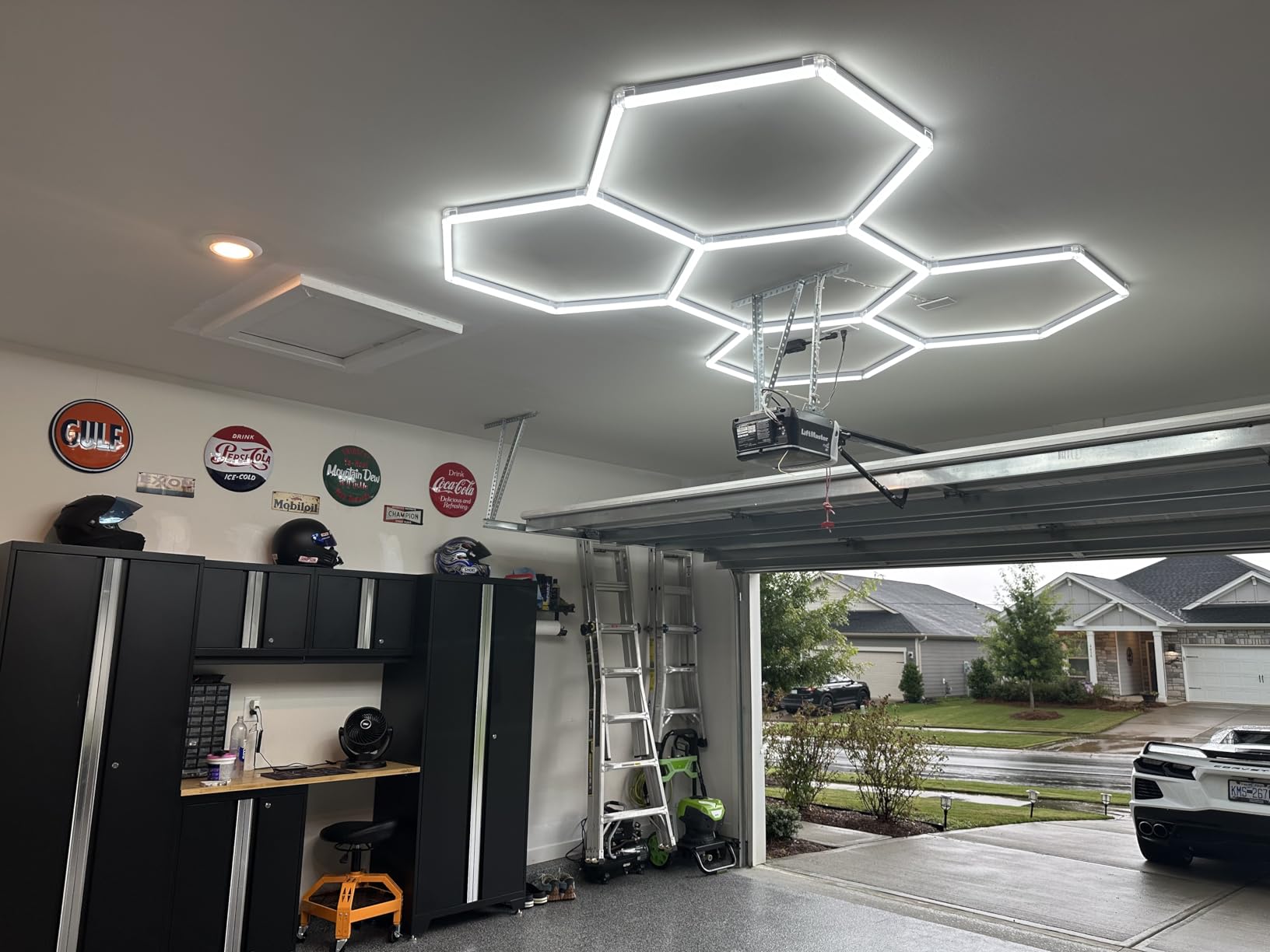
Combining Both: The Hybrid Garage
Why choose one when you can have both? The most successful garage designs we see use a layered lighting approach.
- Layer 1 (The Workhorse): A hexagon grid centered over the main detailing bay or workbench.
- Layer 2 (The Accent): A custom neon sign on the back wall to act as a focal point.
- Layer 3 (The Control): Using dimmable hex kits allows you to drop the brightness when you’re just hanging out, letting the neon sign take center stage.
As noted in our guide on Hybrid Garage Lighting, combining high-output task lights with aesthetic accents creates a space that is both functional and inviting.
Checklist: What You’ll Need for the Install
Before you start, make sure you have these essentials on hand:
- [ ] A Layout Plan: Measure your ceiling twice. Hexagons take up more real estate than you think!
- [ ] Laser Level: Especially for wall-mounted neon or perfectly centered hex grids.
- [ ] Zip Ties or Screw Clips: Most hex kits include both; zip ties are great for wire racks, while clips are for drywall.
- [ ] Tape Measure: Essential for maintaining the 17.5-inch spacing between hexagon centers.
- [ ] A Helper: Holding a 12-foot grid or a 4-foot acrylic sign alone is a recipe for a dropped product.
What to Expect: Common Questions
How long do these lights actually last? Most high-quality LEDs are tested using the IES LM-80-21 standard, which measures lumen maintenance. You can typically expect 30,000 to 50,000 hours of life. In a home garage used 10 hours a week, that’s over 50 years!
Will the hex lights be too bright for a small shop? If you choose a dimmable version, you can adjust the intensity. However, for a standard 10ft ceiling, the brightness is usually perfect for detail work. If your ceiling is lower than 8ft, you might experience some glare, so consider wall-mounting some segments instead.
Can I wire these to a standard wall switch? Yes. Most kits come with a standard US plug, but an electrician can easily hardwire them to a switched outlet or a junction box. Just ensure you follow the National Electrical Code (NEC) for continuous load limits.

Final Thoughts
At the end of the day, the choice between hexagons and neon signs comes down to your primary intent.
If you are chasing perfection in your craft—whether that’s a flawless car finish or a perfectly soldered circuit board—the hexagon grid is your best tool. It provides the technical performance (CRI, lumens, and uniformity) required for high-level tasks.
If you are building a brand, a sanctuary, or a place to relax, the custom neon sign is your best investment. It provides the atmosphere and "wow factor" that a standard light fixture simply can't match.
For the ultimate garage experience? Layer them. Use the hexagons for the "work" and the neon for the "vibe." Your garage—and your projects—will thank you.
Disclaimer: This article is for informational purposes only. Electrical installations should be performed by a qualified professional in accordance with local building codes and safety standards. Always consult a licensed electrician for hardwiring or complex installations.


