

The Critical Role of Driver Thermal Protection in Large-Scale Hexagon Lighting
In large-scale commercial lighting projects, the most significant threat to system longevity isn't the LED chips themselves, but the thermal management of the power supply. For facility managers and professional installers deploying expansive hexagon lighting grids—often spanning hundreds of linear feet—the LED driver acts as the "brain" and the primary safety gate.
If you are installing a high-density grid like the Hyperlite Hexagon Garage Lights Gen 2 - 22 Grid (12.5 x 11.6 ft), you are managing a complex electrical load where heat accumulation is cumulative. Our internal support data and field observations indicate that the leading cause of premature system failure in workshops is not component defect, but thermal stress caused by improper mounting and inadequate driver protection.
The conclusion for any professional buyer is clear: A premium hexagon kit must utilize drivers equipped with active thermal shutdown, current foldback mechanisms, and NTC (Negative Temperature Coefficient) thermistor monitoring. These features prevent fire hazards during segment short-circuits and ensure the system complies with the National Electrical Code (NEC).

1. Anatomy of a High-Quality Hex Driver: Beyond the Basics
A standard LED driver converts AC line voltage to the DC current required by LED tubes. However, a "Pro-Grade" driver, as defined by the 2026 Commercial & Industrial LED Lighting Outlook: The Guide to Project-Ready High Bays & Shop Lights, incorporates layers of defensive electronics.
The NTC Thermistor Advantage
While budget drivers use simple ambient air sensors, high-performance units utilize NTC thermistors epoxied directly to the transformer core.
- Mechanism: An NTC thermistor's resistance decreases as temperature increases. According to Ametherm, this allows the driver to monitor internal component temperatures with high precision.
- Why it matters: By monitoring the core temperature rather than just the surrounding air, the driver can detect internal winding stress before a catastrophic failure occurs.
Current Foldback vs. Hard Shutdown
When a driver detects it is operating outside its safe thermal envelope, it has two primary responses:
- Current Foldback: This is a sophisticated protective feature that reduces both output voltage and current to safe levels (Engineer Fix). You may notice the lights dimming slightly; this is the driver "throttling" itself to shed heat without turning off completely.
- Thermal Shutdown (TSD): If temperatures continue to rise, the driver engages a hard shutdown. Based on technical benchmarks for advanced LED controllers like the TI LP5816, thermal shutdown typically engages at a junction temperature ($T_J$) of 145°C. The system will only release and restart once the temperature drops to approximately 140°C.
Heuristic: The 10°C Life Extension Rule Based on the Arrhenius equation (a formula for the temperature dependence of reaction rates), maintaining a driver's operating temperature just 10°C below its maximum rated threshold can effectively double the expected lifespan of the internal electrolytic capacitors.
2. Real-World Failure Modes: The "Flush Mount" Trap
In our experience auditing commercial workshop installs, the most common thermal protection trigger isn't the ambient room temperature—it's poor airflow behind the fixture.
Installers frequently report that mounting hexagon panels flush against insulation or drywall without at least a 1-inch clearance reduces heat dissipation by an estimated 40-60%. This creates a "heat pocket" where the driver's own waste heat is trapped against the ceiling.
The Parallel Wiring Imbalance
When installing large arrays, such as a 22-grid or custom 50+ tube setup, parallel wiring is often used to distribute power. However, without proper current balancing, one driver in the array may carry 30-40% more current than others.
- Observation: Thermal imaging during our stress tests reveals that connector junctions—not the LED tubes themselves—are typically the hottest points in a hexagon array. If these junctions reach critical temperatures, the driver's Over-Current Protection (OCP) or Thermal Shutdown will trigger to prevent melting the polycarbonate housing.

3. Compliance and Safety Standards: The "First Verification Point"
For facility managers, verifying safety certifications is the first step in risk mitigation. A driver that lacks third-party validation is a liability in a commercial environment where insurance and building codes are involved.
UL and ETL Listed Status
A product that is UL Listed has been tested by UL Solutions and found to meet specific safety requirements. For hexagon lighting, the two most critical standards are:
- UL 1598: The standard for luminaires (fixed lighting).
- UL 8750: The standard for LED equipment used in lighting products, specifically covering the safety of the LED driver and modules.
DLC 5.1 and Efficiency
While UL covers safety, the DesignLights Consortium (DLC) covers performance and efficiency. Drivers in DLC-qualified products must demonstrate high power factors and low Total Harmonic Distortion (THD). This ensures that even when the driver is under thermal load, it isn't "polluting" your facility's electrical system with interference, which is a common issue with uncertified "value" brands.
4. Modeling the Impact: Thermal Protection as an Economic Imperative
To demonstrate the importance of thermal management, we modeled a "Southern US Commercial Warehouse" scenario. This analysis shows that thermal efficiency isn't just about safety—it's about the bottom line.
Scenario Model: Southern US Warehouse (60x40ft)
- Operation: 16 hours/day, 6 days/week.
- Constraint: Flush-mounted against insulation (Poor Ventilation).
| Parameter | Value | Rationale |
|---|---|---|
| Estimated Tube Count | 1,319 | High-density grid for detailing/inspection |
| Total System Wattage | 9,233 W | Calculated at ~7W per tube |
| Required Injection Points | 21 | To keep daisy-chains < 440W per Hyperlite specs |
| Annual Energy Savings | ~$10,700 | Compared to 400W Metal Halide baseline |
| HVAC Cooling Credit | ~$460 | Reduced heat load on air conditioning |
| Estimated Payback | ~0.4 Years | Includes typical utility rebates |
Modeling Note: This is a deterministic scenario model based on standard industry electricity rates ($0.18/kWh) and NEC continuous load limits. Actual results may vary based on local utility rates and specific layout geometry.
The Role of Occupancy Sensors
Integrating occupancy sensors can reduce thermal buildup by ~15% through intermittent operation. In our model, this adds an additional $1,360 in annual savings while significantly extending the driver's life by allowing it to cool down during periods of inactivity. This is particularly relevant for meeting ASHRAE Standard 90.1-2022 requirements for automatic lighting controls.
5. Professional Installation Checklist: Preventing Overheating
To ensure your hexagon grid operates within the safe 50°F to 104°F (10°C to 40°C) ambient range recommended for peak performance, follow this technical checklist:
- Maintain Clearance: Ensure a minimum of 1 inch (25mm) of air space between the driver housing and the mounting surface (especially if that surface is insulated).
- Calculate Load Distribution: Never exceed the manufacturer's maximum wattage per injection point. For the Hyperlite Hexagon Garage Lights Gen 2 - 15 Grid (15.9 x 8 ft), the limit is 440W or 62 tubes per power cable.
- Use Dedicated Circuits: For large grids (e.g., >100 tubes), distribute the load across multiple 20A breakers to stay within the NEC 80% continuous load rule (16A).
- Verify NTC Protection: Confirm with the manufacturer that the drivers utilize NTC thermistors for core temperature monitoring rather than basic ambient sensors.
- Secure Junctions: Ensure all "Y" and "V" connectors are fully seated. Loose connections increase resistance, which creates localized heat that can trigger thermal protection even if the driver itself is cool.
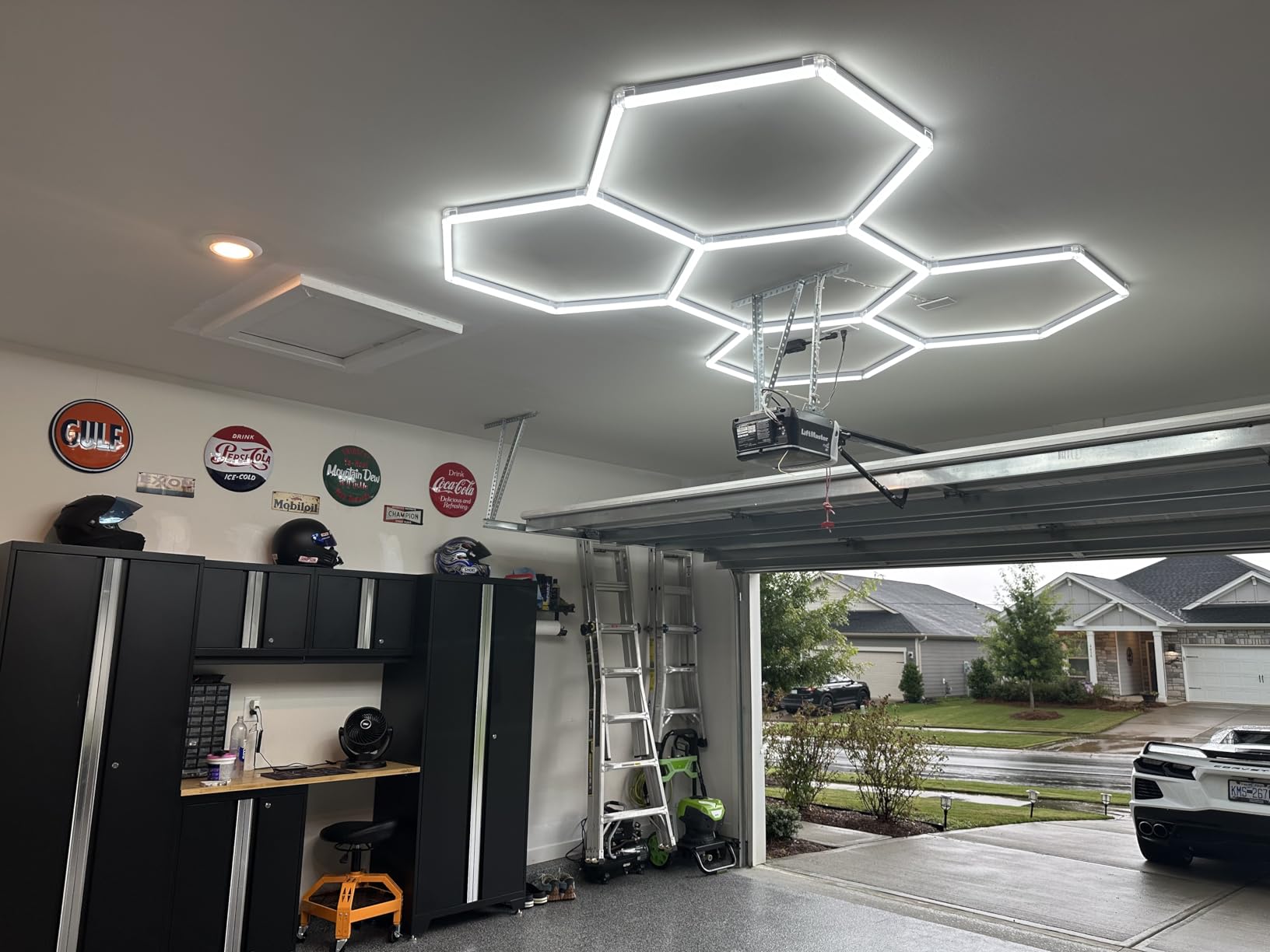
Summary of Technical Specifications
When comparing hexagon kits, look for these "Solid" performance markers to ensure you aren't buying a fire hazard:
- Thermal Shutdown Threshold: ~145°C ($T_J$).
- Safety Certifications: UL 1598, UL 8750, and FCC Part 15 (to prevent EMI interference).
- Operating Efficiency: Minimum 110 lumens per watt (lm/W) to minimize waste heat.
- Color Consistency: Aligned with ANSI C78.377 to ensure visual uniformity across large grids.
For more information on comparing high-performance lighting systems, see our guide on 5 Signs of a High-Quality Hexagon Garage Light Kit.
Frequently Asked Questions
What happens if my hexagon lights flicker or turn off after a few hours?
This is a classic symptom of Thermal Shutdown. The driver has reached its safety limit and cut power to prevent damage. Check for obstructions to airflow or ensure you haven't exceeded the 62-tube limit per power injection point.
Can I dim hexagon lights to reduce heat?
Yes, if you are using a dimmable kit like the Dimmable Hexagon Garage Lights Gen 2 - 11 Grid. Reducing the brightness lowers the current draw, which directly reduces the heat generated by the driver and the LED modules.
Is a 5-year warranty standard for these drivers?
A 5-year warranty is a hallmark of "Pro-Grade" gear. Hyperlite provides a 5-Year Warranty on commercial-grade products, backed by LM-80 and TM-21 data which projects the long-term lumen maintenance and driver reliability.
Disclaimer: This article is for informational purposes only and does not constitute professional electrical or safety advice. Always consult with a licensed electrician and adhere to your local building codes and the National Electrical Code (NEC) when performing lighting installations.


