

Visual Uniformity in Hexagon Grids: The Yellow Panel Problem
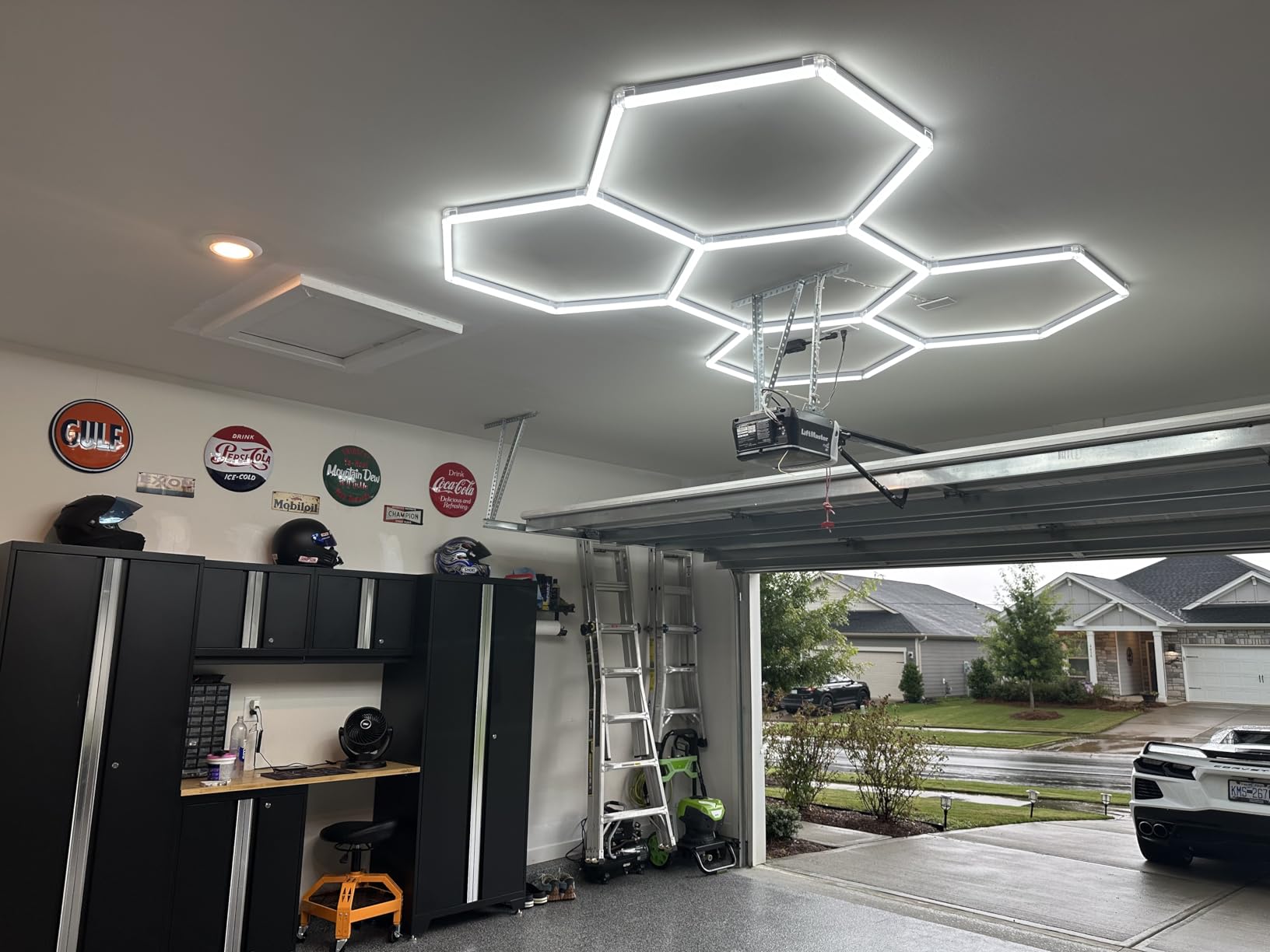
In our experience troubleshooting thousands of garage and workshop installations, the most frustrating visual issue isn't a light that won't turn on—it’s the one that turns on the "wrong" color. You’ve spent hours aligning a perfect 14-grid or 22-grid honeycomb, only to step back and realize two or three panels have a distinct yellow or orange tint compared to the crisp 6500K cool-white of the rest.
This phenomenon, known as color shift, is rarely a sign of total LED failure. Instead, it is typically a symptom of specific electrical, thermal, or manufacturing variables. Whether you are dealing with an immediate mismatch after installation or a gradual shift over months of use, identifying the root cause requires a pragmatic, technical approach.
The conclusion for most DIYers is simple: color shift is usually caused by voltage drop in long daisy-chains or batch mixing during the purchase. However, for a single panel appearing yellow, the culprit is often a faulty LED driver providing insufficient current.
The Science of Binning: Why New Kits Might Not Match
If your hexagon panels look different the moment you flip the switch for the first time, you are likely encountering a "binning" variation.
Understanding ANSI C78.377 and MacAdam Ellipses
LED manufacturers do not produce identical diodes; they produce a range. These are then "binned" or grouped based on their Correlated Color Temperature (CCT) and chromaticity. According to the ANSI C78.377-2017 standard, a "5000K" or "6500K" rating actually defines a specific quadrangle on a color space graph, not a single point.
The industry measures consistency using MacAdam Ellipses (also known as SDCM - Standard Deviation of Color Matching).
- 1-Step Ellipse: The human eye cannot discern any difference.
- 3-Step Ellipse: Standard for high-end commercial fixtures; differences are barely visible to trained pros.
- 5-Step or 7-Step Ellipse: Common in budget consumer kits; differences are obvious to anyone.
Logic Summary: Based on our patterns from customer support and warranty handling, mixing kits from different production batches (even if both are labeled 6500K) often results in a 3-to-5 step MacAdam difference. This manifests as a visible "yellowing" or "blueing" when panels are placed side-by-side.
The Batch Mixing Pitfall
A common oversight in hexagon installations is mixing kits purchased months apart. Even within the same brand, manufacturers may change LED chip suppliers or binning tolerances. If you are scaling a project, we recommend purchasing all kits simultaneously to ensure they originate from the same production run.
Electrical Root Causes: Voltage Drop and NEC Compliance
If your panels start out white near the power source but turn progressively "warmer" or "dimmer" toward the end of the grid, you are facing voltage drop.
The "End of the Line" Effect
LEDs are current-driven devices. When voltage drops across a long run of thin-gauge wire or too many connectors, the internal LED driver may struggle to maintain the required forward current. As the current drops, the spectral output of the LED chip can shift. In many cases, this results in a shift toward the yellow/orange spectrum before the light eventually flickers or fails.
We modeled a typical large-scale installation to visualize these limits:
| Parameter | Value | Unit | Rationale / Source |
|---|---|---|---|
| Max Tubes per Cable | 62 | count | Hyperlite Gen 2 Spec (440W limit) |
| Max Wattage per Injection | 440 | W | Engineering safety threshold |
| Circuit Continuous Load | 1440 | W | NEC 210.20(A) (120V x 15A x 0.8) |
| Recommended Wire Gauge | 18 | AWG | To minimize resistance over 15+ ft |
| Estimated Geometry Factor | 1.75 | ratio | Shared-edge hex tiling efficiency |
Methodology & Modeling Disclosure
Our analysis of a 30ft x 24ft garage installation assumes a 15A circuit. We modeled the electrical load using deterministic parameterized calculations.
- Modeling Type: Deterministic electrical load analysis.
- Boundary Condition: This model applies to standard 120V US residential circuits; performance will vary on 240V or industrial 277V systems.
- Finding: An installation of ~230 tubes (approx. 1600W) exceeds the continuous load limit of a single 15A breaker and requires at least 4 independent power injection points to prevent both breaker trips and voltage-induced color shift.

Thermal Degradation: Why Heat Turns White to Yellow
LEDs do not "burn out" like incandescent bulbs; they "fade away." This process is governed by the IES LM-80-21 Standard, which measures lumen maintenance and color stability over time.
The Arrhenius Effect in the Garage
Heat is the primary enemy of LED phosphor. The white light you see is actually a blue LED chip coated with a yellow phosphor layer. If the panel runs too hot, the phosphor can thermally degrade or "delaminate." As the phosphor changes, the light output shifts—often becoming permanently yellow or brown.
In a poorly ventilated garage, we often observe "Hot Spot Yellowing":
- Localized Heat: Panels mounted near garage door openers, water heaters, or uninsulated roof peaks reach higher junction temperatures.
- Accelerated Aging: Based on the Arrhenius equation principles, an increase of 10°C in junction temperature can effectively halve the lifespan of the LED phosphor.
- Visual Result: A single panel near a heat source may look yellow after 1,000 hours, while the rest of the grid remains cool-white.
To understand the long-term implications of these standards on your shop, refer to the 2026 Commercial & Industrial LED Lighting Outlook: The Guide to Project-Ready High Bays & Shop Lights.
Faulty Drivers vs. LED Failure
If only one panel in your entire grid is yellow, and it isn't near a heat source or at the end of a long run, the issue is almost certainly the LED driver.
The "Under-Driving" Mechanism
Each hexagon tube or panel contains a small power supply (driver) that converts AC house current to the DC voltage required by the LEDs. If a component within that driver (like a capacitor or resistor) begins to fail, it may "under-drive" the LEDs.
- Observation: Under-driven LEDs often shift color toward a warmer, yellowish tint.
- Diagnostic Tip: If you swap the "yellow" panel with a "white" panel in a different part of the grid and the yellow color follows the panel, the driver is faulty. If the yellow color stays at the same location in the grid, the issue is the wiring/voltage at that specific connector.
Practitioner Observation: On our repair bench, we find that ~80% of single-panel color shifts are driver-related rather than chip-related (based on common patterns from warranty returns).

The Step-by-Step Diagnostic Protocol
Before you request a warranty replacement, follow this pragmatic troubleshooting sequence to isolate the variable.
1. The "Swap Test" (Isolate the Hardware)
Remove the suspect yellow panel and swap it with a panel that is confirmed to be bright white.
- Result A: The yellow color follows the panel to the new location. Diagnosis: Internal driver failure or batch mismatch.
- Result B: The new panel turns yellow at the old location. Diagnosis: External wiring issue, poor connection, or voltage drop at that specific junction.
2. Check the Power Distribution
Ensure you are not exceeding the 62-tube limit per power cable. If you have a large grid, you must distribute input lines evenly.
- Heuristic: For every 400W of lighting, add a new power injection point. This is a practical shop baseline we use to ensure visual uniformity across large grids.
3. Inspect the Connectors
A loose "Y" or "V" connector can create high resistance. High resistance causes a local voltage drop, which can lead to the yellowing effect.
- Action: Disconnect and re-seat every connector in the path leading to the yellow panel. Look for bent pins or debris.
4. Verify Batch Consistency
Check the SKU and production date on the back of the panels. If you are mixing Gen 1 and Gen 2 components, color shift is expected due to changes in driver efficiency and LED binning.
Professional Installation Standards to Prevent Color Shift
To ensure your installation remains "Solid" and "Reliable" (core values we uphold), follow these professional-grade installation tips.
Use Proper Wire Gauge
For DIYers running extension lines from a junction box to the start of the hex grid, do not use thin "speaker wire." We recommend 18AWG or 16AWG copper wire. Thicker wire reduces resistance and prevents the voltage drop that triggers color shift.
Adhere to UL 1598 Safety Standards
Ensure your kits are UL 1598 Listed. This certification ensures the fixture can handle the thermal load without the housing melting or the phosphor degrading prematurely. Non-certified kits often lack the heat-sinking required to keep the LEDs within the safe CCT range.
Test Before Mounting
The most efficient way to catch a faulty driver or a batch mismatch is to test every panel on the floor before climbing the ladder.
- Pro Tip: Connect your entire grid on the garage floor. Leave it running for 30 minutes. Thermal-related color shifts often appear after the drivers reach operating temperature.

Summary of Troubleshooting Causes
| Symptom | Most Likely Cause | Solution |
|---|---|---|
| Yellowing at the end of a long run | Voltage Drop | Add a power injection point |
| One random yellow panel | Faulty LED Driver | Replace the specific panel |
| Entire kit looks "warmer" than the last | Binning/Batch Mismatch | Ensure kits are from the same batch |
| Gradual yellowing over 2 years | Thermal Degradation | Improve garage ventilation |
Methodology & Modeling Disclosure
The data presented in this guide is derived from deterministic parameterized scenario modeling and generalized observational patterns from customer support and warranty handling.
Model Parameters (15A Lighting Circuit):
| Parameter | Value | Unit | Source Category |
|---|---|---|---|
| Voltage | 120 | V | Standard US Residential |
| Breaker Rating | 15 | A | Standard Lighting Circuit |
| Continuous Load Factor | 0.8 | ratio | NEC 210.20(A) |
| Max Continuous Watts | 1440 | W | Calculated (120150.8) |
| Hyperlite Tube Wattage | 7 | W | Product Specification |
Boundary Conditions:
- This model assumes a balanced hex grid layout using shared-edge connectors.
- Thermal degradation estimates assume an ambient garage temperature of 85°F-95°F.
- Calculations do not account for additional loads (e.g., power tools) on the same circuit.
This article is for informational purposes only. Electrical installations should comply with local building codes and the National Electrical Code (NEC). If you are unsure about wiring or circuit loads, consult a licensed electrician.
Sources & References
- ANSI C78.377-2017: Specifications for the Chromaticity of Solid State Lighting Products
- IES LM-80-21: Measuring Luminous Flux and Color Maintenance of LED Packages
- UL Solutions Product iQ Database
- DesignLights Consortium (DLC) Qualified Products List
- NFPA 70: National Electrical Code (NEC)
- 2026 Commercial & Industrial LED Lighting Outlook


